
Ceramic mugs are relatively easy to identify by their body dimensions, but their handles make packaging design more complicated.
A mug may fit inside a box based on its height and body diameter, yet the handle can still touch the box walls, interfere with the insert or create pressure during handling.
For brands sourcing custom ceramic mug packaging boxes, the insert needs to accommodate the complete mug shape, not just the main body.
The key considerations are handle clearance, body support, cavity dimensions, insert material and the final packing arrangement.
This guide explains what to check when developing custom packaging for single ceramic mugs, multiple mugs and ceramic gift sets.
1. Why Mug Handle Clearance Matters
Unlike cylindrical products, ceramic mugs have an extended handle that changes their overall dimensions and creates an additional area requiring protection.
Three areas need particular attention.
Handle projection
The handle extends beyond the main mug body. If the insert cavity is designed using only the body diameter, the handle may press against the cavity wall or outer box.
Handle opening
The internal opening of the handle needs sufficient space to remain free from unnecessary contact with the insert structure.
Handle-to-body connection
The connection between the handle and mug body is an important area to protect. The packaging should not rely on the handle as the main load-bearing support.
A suitable insert should hold the mug through appropriate support points around the body and base while keeping the handle clear of surrounding packaging components.
The objective is to prevent unwanted movement without applying excessive pressure to the ceramic surface or handle.
2. Measure the Mug Before Designing the Insert
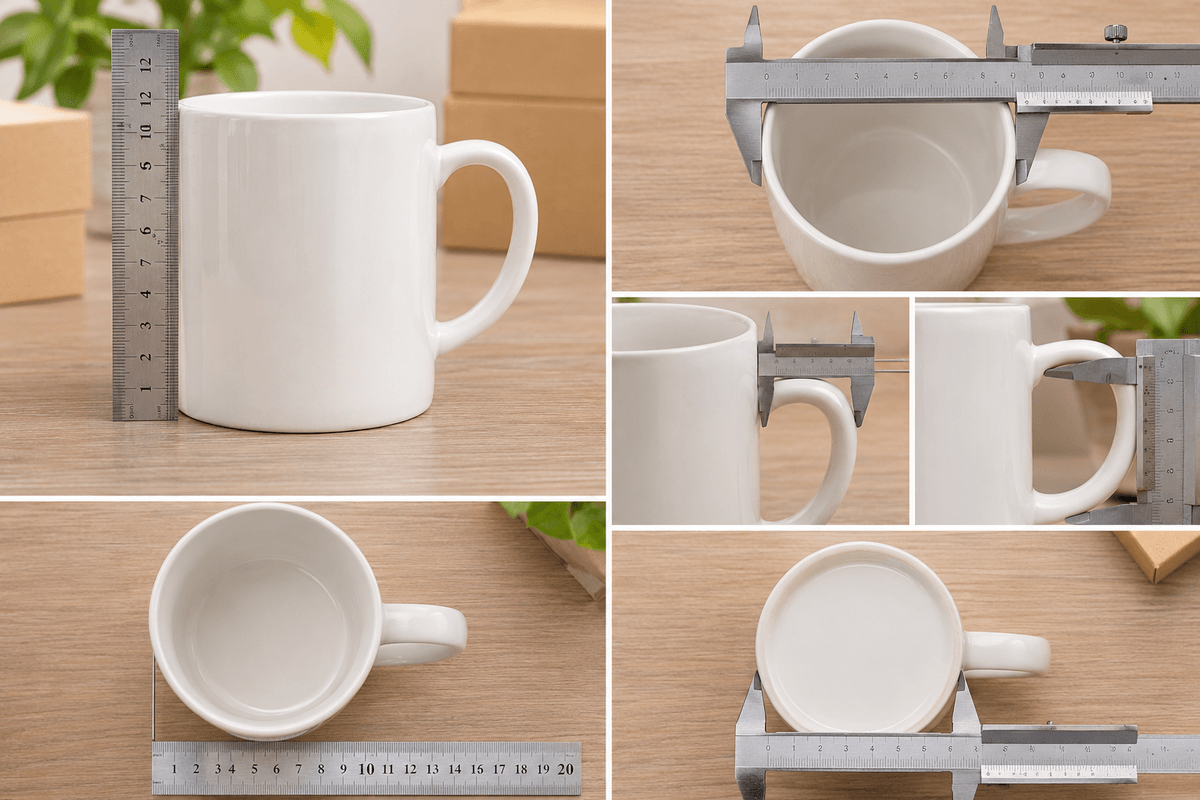
Accurate product measurements are the starting point for custom ceramic mug packaging.
Providing only the mug height and diameter is not enough.
Before developing the box and insert, prepare the following measurements:
- Mug height: From the bottom of the base to the highest point of the rim.
- Body diameter: Measure the widest part of the main mug body.
- Base diameter: Check the bottom footprint, especially if the mug has a narrower base.
- Overall width: Measure from the outer edge of the handle to the opposite side of the mug body.
- Handle projection: Measure how far the handle extends beyond the body.
- Handle opening: Record the internal width and height of the handle opening.
- Product weight: Provide the weight of one empty mug.
For mugs with unusual shapes, tapered bodies, oversized handles or irregular profiles, provide photos from the front, side, top and bottom.
The following reference helps distinguish the measurements needed for insert
| Measurement | Packaging Purpose |
|---|---|
| Mug height | Determines vertical box and insert space. |
| Body diameter | Defines the main holding cavity. |
| Base diameter | Helps determine bottom support. |
| Overall width | Accounts for the handle projection. |
| Handle opening | Helps assess handle clearance. |
| Mug weight | Helps determine insert support requirements. |
Do not calculate the insert cavity using the mug body diameter alone.
The actual sample should be measured before the final cavity dimensions are confirmed.
3. How to Design Handle Clearance in a Mug Insert
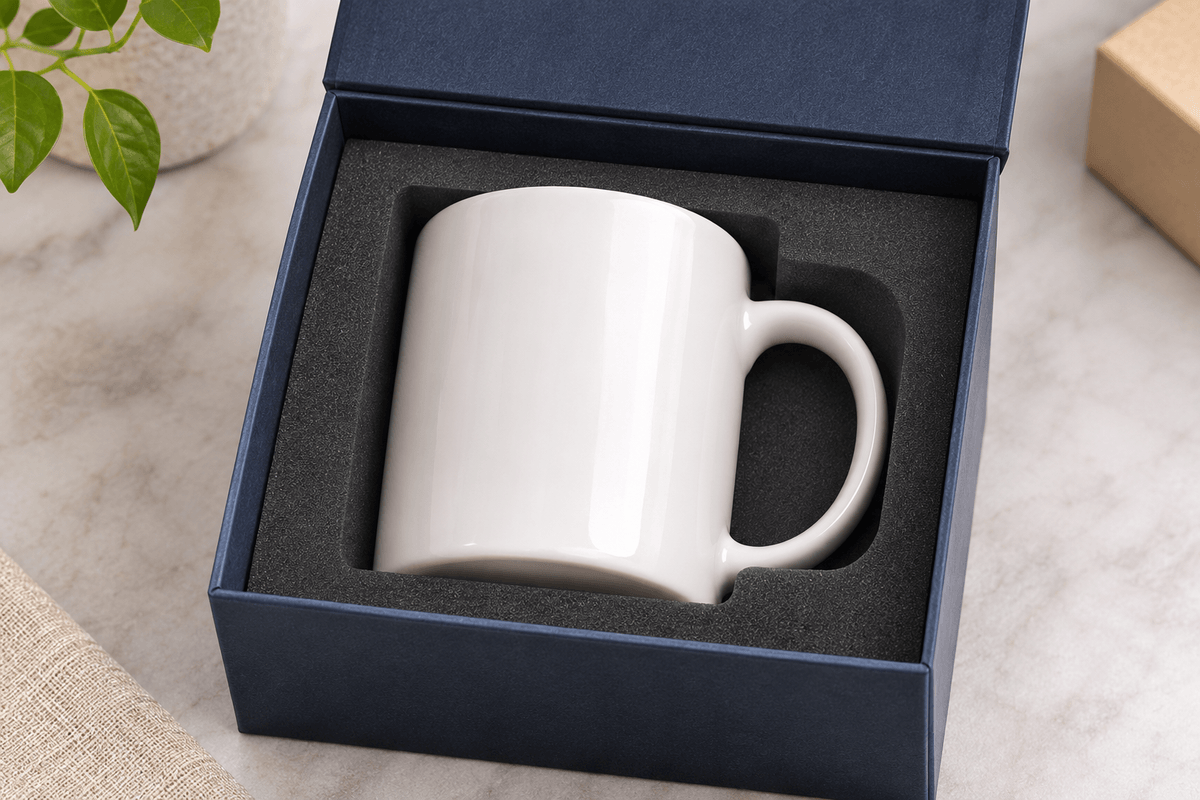
Handle clearance is one of the most important details in ceramic mug packaging.
The insert should provide enough room for the handle without allowing the mug to move excessively inside the box.
Keep the Handle Away from the Outer Box
The handle should not press directly against the inside walls of the outer box.
A dedicated recessed area or open clearance zone can be designed around the handle, depending on the insert structure.
This reduces the risk of direct contact during normal handling.
Support the Mug Body and Base
The insert should provide stable contact points around suitable areas of the mug body and base.
The design should prevent the mug from shifting while avoiding excessive pressure on the rim, handle or other vulnerable areas.
Allow for Manufacturing and Product Variations
Not every mug from a production batch will have precisely identical dimensions.
Small differences in body diameter, handle shape and overall width can affect the final fit.
The insert design should account for the actual product dimensions and agreed tolerances.
There is no single clearance measurement suitable for every ceramic mug.
The required space depends on the handle shape, insert material, product variation and intended packing conditions.
Check the Removal Process
A mug should be easy to remove from its packaging without forcing the handle through a narrow opening.
If the handle catches on the insert during removal, the cavity may need adjustment.
For more information about material selection and cavity design, see our Custom Inserts solutions.
4. Choosing the Right Insert Material for Ceramic Mugs
Different insert materials offer different combinations of support, cushioning, appearance and production cost.
For ceramic mug packaging, the choice should be based on the mug's shape, weight, order quantity and packaging purpose.
Paperboard Inserts
Paperboard inserts can be used to create fitted cavities, partitions and internal support structures.
They are worth considering for retail packaging and projects where organized presentation and efficient material use are priorities.
For multiple mugs, paperboard dividers can help separate individual products and reduce direct contact between them.
However, the insert structure needs to be designed carefully to provide suitable support for the mug and its handle.
Molded Pulp Inserts
Molded pulp can be developed into shaped trays that follow the product's general contours.
It is an option for brands considering molded-fiber packaging and reduced plastic components.
The cavity shape, thickness and support areas need to be reviewed according to the actual mug dimensions and weight.
EVA and Foam Inserts
EVA and other foam materials can be cut into customized cavities for individual ceramic products.
They are worth considering when a project requires more tailored cushioning, a premium presentation or a specific internal layout.
For mugs with unusual handles, the foam cavity can be designed with a dedicated handle clearance area.
Material density, thickness, surface contact and cavity dimensions should all be checked during sampling.
The most suitable material is not necessarily the most expensive one. It is the material that meets the agreed protection, presentation and budget requirements.
For a broader comparison of insert materials, see our guide: How to Choose the Right Insert for Product Protection and Presentation.
5. Single Mug Boxes vs. Multiple Mug Packaging
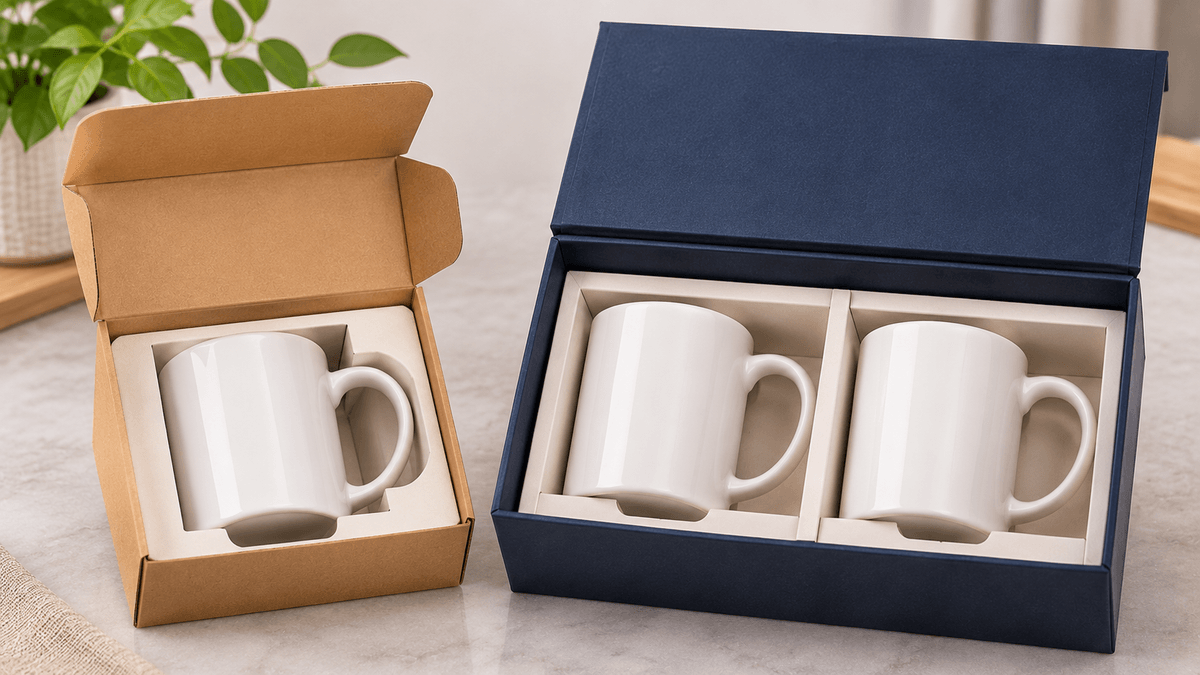
The insert layout changes considerably depending on how many mugs are packed together.
Single Ceramic Mug Packaging
A single mug box usually requires one main cavity with enough room for the body, base and handle.
The insert should keep the mug in its intended position and prevent the handle from contacting the outer box.
For premium gift packaging, a custom rigid box can provide a more substantial presentation.
For standard retail applications, a custom folding carton may be considered when the product weight and protection requirements allow.
Explore our Custom Rigid Boxes and Custom Folding Boxes for different packaging structures.
Two-Mug Packaging
When two mugs share one box, their handles create an additional design challenge.
The insert needs to prevent:
- Handle-to-handle contact.
- Mug body-to-mug body contact.
- Handles touching the outer box walls.
- Excessive movement inside individual cavities.
Separate cavities and dividers can help organize the two mugs.
The handle direction should be confirmed through the actual product layout rather than assumed during the initial design.
Ceramic Mug Gift Sets
Some brands sell mugs together with coasters, spoons, tea accessories or other small gift items.
In these cases, the packaging needs more than a simple mug cavity.
A customized insert can provide separate compartments for:
- Ceramic mugs.
- Coasters.
- Spoons.
- Small accessories.
- Gift cards or printed information.
The layout should keep the accessories from contacting the ceramic surfaces during handling.
For home décor and lifestyle products, explore our Home Décor & Lifestyle Packaging solutions.
6. What to Check Before Approving a Mug Packaging Sample
A packaging sample should be checked with the actual ceramic mug, not just a drawing or estimated product size.
Before approving mass production, review the following details.
1. Overall fit
Does the mug fit inside the cavity without forcing the handle into position?
2. Handle clearance
Is there sufficient space around the handle and its opening?
3. Body and base support
Does the insert hold the mug securely without putting unnecessary pressure on the rim or handle?
4. Lid clearance
Can the box close properly without pressing against the mug or handle?
5. Removal and replacement
Can the mug be taken out and returned to the insert without catching or damaging the packaging?
6. Multiple-product separation
For multi-mug sets, do the handles and bodies remain separated?
7. Packed arrangement
Does the assembled packaging maintain the intended product position when placed inside the proposed shipping carton?
If the project requires formal transit or drop testing, the test method and acceptance criteria should be agreed separately.
A simple sample fitting check should not be treated as proof of shipping performance.
7. Information Needed for a Custom Ceramic Mug Box Quote
To review a ceramic mug packaging project, prepare the following information:
| Information | Details to Provide |
|---|---|
| Product | Single mug, two mugs or gift set. |
| Mug dimensions | Height, body diameter and base diameter. |
| Handle dimensions | Overall width, projection and opening size. |
| Product weight | Weight per mug. |
| Box style | Rigid box or folding carton. |
| Insert preference | Paperboard, molded pulp, EVA or foam. |
| Printing and finishing | Artwork, logo and surface requirements. |
| Quantity | Number of sets per design. |
| Sales channel | Retail, gifting or e-commerce. |
| Destination | Target country and shipping requirements. |
Product photos and an actual mug sample are especially useful when the handle has an unusual shape.
If you are still preparing your packaging requirements, our Packaging Insert Quote Checklist explains what buyers should prepare before requesting a custom insert quotation.
Custom Ceramic Mug Packaging by QX Packs
QX Packs manufactures custom packaging boxes and fitted inserts for home décor, ceramics, glassware and lifestyle products.
Since 2004, we have supported custom packaging projects with different box structures, materials, printing, finishing and insert configurations.
For ceramic mug projects, we can review the outer box structure, handle clearance, insert layout and product dimensions before sampling.
Whether you need a single mug gift box, two-mug packaging or a ceramic gift set, the packaging should be developed around the actual product rather than a standard box size.
Send us your mug dimensions, product photos, weight, quantity per design and preferred packaging style to discuss your project.
Ready to Develop Your Custom Ceramic Mug Boxes?
Whether you need single mug boxes, multiple mug packaging or ceramic gift sets, QX Packs can help review your box structure, insert design and packaging specifications.
How much clearance should a ceramic mug handle have inside a box?
There is no universal clearance measurement for every mug. The required space depends on the handle dimensions, insert material, product tolerances and outer box structure. It should be confirmed using the actual mug sample.
Should the mug handle be supported by the insert?
The handle should generally not be used as the primary load-bearing support. The insert should support suitable areas of the mug body and base while keeping the handle clear of unnecessary pressure and contact.
Which insert material is suitable for ceramic mug packaging?
Paperboard, molded pulp, EVA and foam are possible options. The choice depends on mug weight, handle shape, protection requirements, order quantity and presentation preferences.
Can two ceramic mugs be packed in one gift box?
Yes. A custom insert can be designed with separate cavities and partitions for each mug. Handle orientation and clearance between the products should be confirmed during sampling.
Can ceramic mug packaging include coasters and spoons?
Yes. Separate compartments can be developed for mugs, coasters, spoons and other accessories. The layout should prevent accessories from moving into contact with the ceramic products.
What information is needed to quote custom ceramic mug boxes?
Provide the mug dimensions, handle measurements, product weight, photos, number of mugs per box, preferred box style, insert requirements, order quantity and delivery destination.