
A barcode may look correctly positioned on a flat packaging dieline but become difficult to scan after the carton is folded, glued and filled.
The problem is not always the barcode artwork itself. A fold line may sit too close to the printed bars, a glue flap may cover part of the code, or the finished carton may place the barcode on an awkward surface.
For brands ordering custom folding cartons, barcode placement should be reviewed on both the flat artwork and the assembled box before production approval.
This guide focuses on the practical layout decisions that packaging buyers and designers need to confirm with their manufacturer.
Quick Answer: Where Should a Barcode Go on a Folding Carton?
For retail products scanned at checkout, GS1 generally identifies the lower-right area of the back panel as a preferred barcode location, provided the required clearances and other placement rules are met.
However, this is not a universal rule for every product or barcode type.
The final position depends on the barcode format, carton structure, retailer requirements and how the product will be handled or scanned.
Before approving the artwork, confirm that the barcode:
- Is on the intended finished carton panel
- Does not cross a fold, cut line or glued overlap
- Remains visible and accessible after assembly
- Has the required quiet zones around the symbol
- Uses suitable print contrast and surface finishing
- Can be checked on an actual printed, assembled sample
A flat dieline alone cannot confirm all these conditions.
1. Confirm the Barcode Type and Retailer Requirements
Start by identifying what the barcode is for.
A retail product barcode used at checkout may have different requirements from a code used for warehouse tracking, internal production or consumer information.
Before preparing the final artwork, the buyer should provide:
- Barcode artwork in a suitable production format
- Barcode type, such as UPC-A or EAN-13, where applicable
- Intended sales country and retail channel
- Any retailer-specific placement or printing requirements
- The approved product identification information
For brands selling through several retailers, it is worth checking their packaging guidelines before fixing the barcode position.
Do not use an automatically generated or resized barcode image without confirming that it meets the applicable requirements.
The brand or barcode owner should confirm the encoded information and its intended use. The packaging manufacturer can then review how the supplied artwork fits the proposed carton structure.
2. Choose the Correct Panel on the Dieline
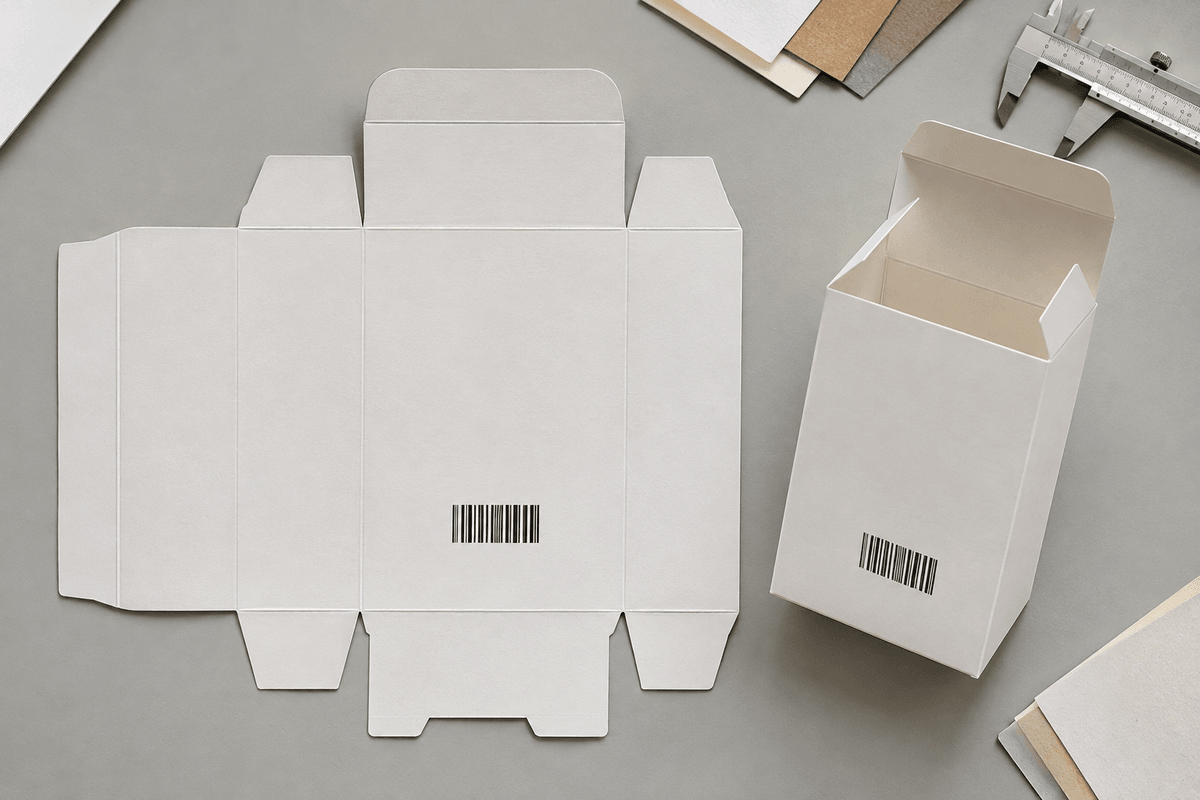
A folding carton dieline shows the box before assembly. It includes the front, back, sides, top and bottom panels, together with cutting lines, crease lines and glue flaps.
A barcode placed in an apparently empty area may cause problems if that area becomes a fold, overlap or partially concealed panel.
For example, consider a small folding carton containing a charger:
The designer places the barcode near the bottom of the flat artwork. After folding, that area sits close to the bottom closure flap. The printed bars may remain visible, but the required clear space around them could be affected.
Another problem occurs when a barcode is positioned near the glue flap. Once the carton is assembled, the overlapping panel may cover part of the barcode or its surrounding space.
When reviewing the dieline, check:
- Which panel will become the back of the finished carton
- Where the nearest fold and cutting lines are located
- Whether glue flaps or closure panels could overlap the barcode
- Whether the barcode remains on one reasonably flat surface
- Whether the symbol and quiet zones have sufficient clearance
The barcode should not be folded around a corner or interrupted by a carton construction feature.
For projects that require a different structure, see our custom folding boxes.
3. Check the Barcode Area After the Carton Is Folded
A barcode should be reviewed in its final packaging position, not only on a computer screen.
Consider a retail folding box with a hanging tab.
The back panel may appear suitable for barcode printing. However, the tab, top closure, internal flaps or retail display arrangement can affect accessibility.
A barcode may also become difficult to reach with a scanner when it is too close to an edge or placed on a narrow side panel.
For products sold in retail stores, the buyer should confirm whether the chosen position is practical for the intended scanning process.
The key question is: Can the code be accessed and scanned when the package is fully assembled and filled?
This is particularly relevant for compact electronics packaging, where product information, warning text, graphics and a barcode must share limited carton space.
4. Review Printing Surface, Contrast and Finishing
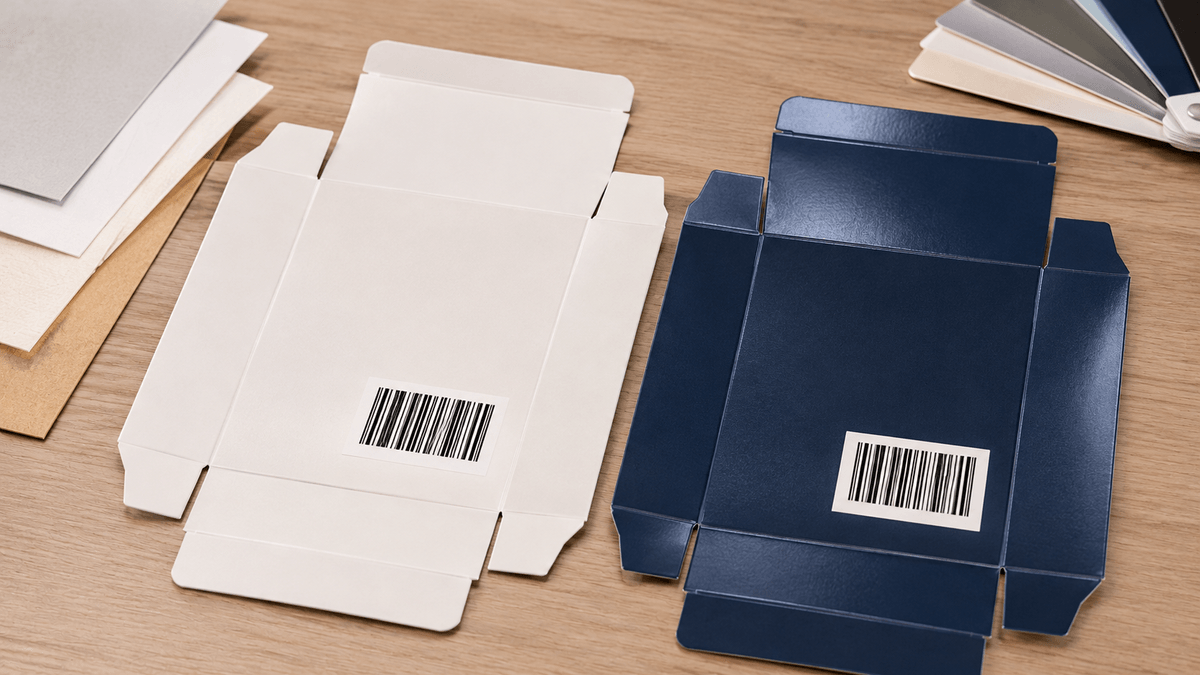
Barcode readability depends on more than position.
The printed bars, spaces and surrounding quiet zones must meet the applicable barcode specifications.
Several packaging design choices can affect the result.
Dark or Colored Backgrounds
A barcode printed over a dark or decorative background may have insufficient contrast.
For many standard retail applications, dark bars on a light background are a practical choice, but the actual colors must be checked against the applicable specifications.
Do not assume that a visually attractive color combination will scan reliably.
Textured Paperboard
Rough or heavily textured paper can affect print definition.
If the carton uses textured stock, confirm that the proposed barcode area can be printed with the required clarity.
Lamination and Special Finishes
Glossy coatings, metallic effects or other reflective finishes may interfere with certain scanning conditions.
If the carton uses foil stamping, spot UV or other special finishes, keep the barcode and required quiet zones clear of decorative treatments that could affect readability.
Barcode Size and Quiet Zones
The barcode must retain the dimensions and clear spaces required for its specific symbology and application.
Avoid stretching, compressing or arbitrarily resizing the barcode to fit a narrow panel.
If the artwork does not fit, review the layout or regenerate the barcode artwork to the correct specification rather than distorting it.
5. Check the Printed and Assembled Carton Sample
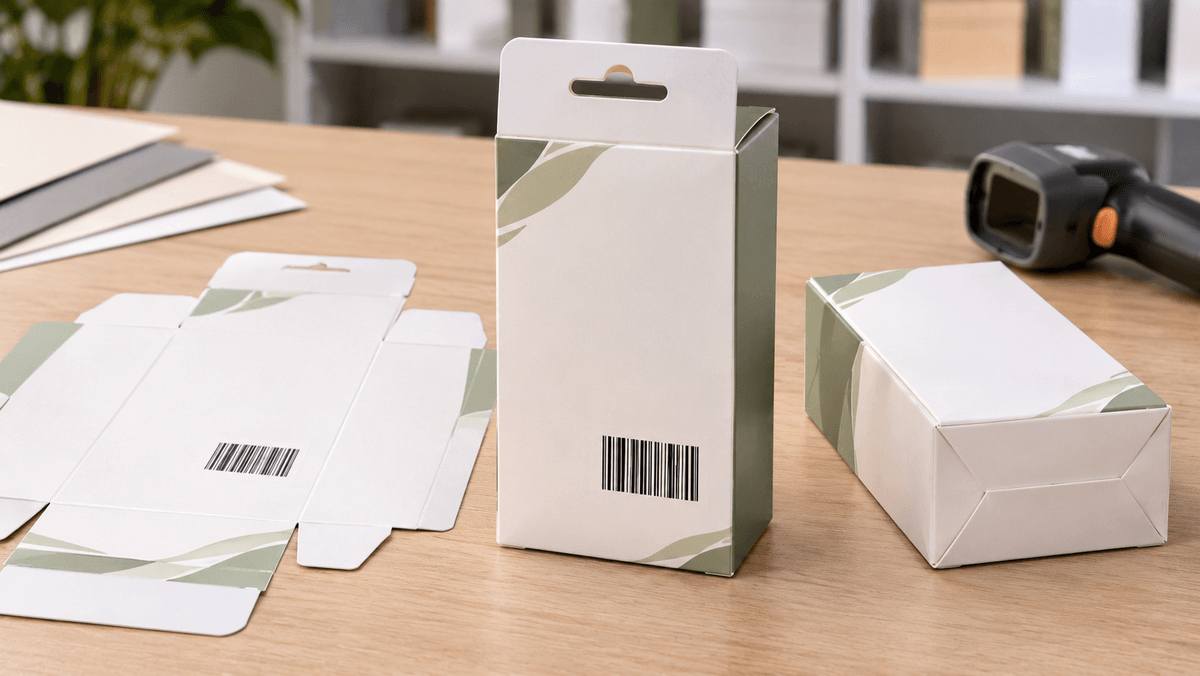
Before mass production, use a printed sample made with the intended carton material, printing method and finishing requirements.
Check the barcode after the box has been folded and glued.
A practical sample review should confirm:
- Position: The barcode is on the approved finished panel.
- Visibility: No flap, edge or overlap obscures the symbol.
- Print quality: The bars and spaces appear clean, without obvious distortion or damage.
- Surface: Coating, texture and reflected light do not create an apparent scanning problem.
- Scanning: The code can be tested with appropriate equipment under the intended use conditions.
A successful scan with one handheld scanner is useful feedback, but it does not prove that a barcode meets a formal print-quality grade.
If the buyer or retailer requires formal barcode verification, the applicable standard, verification method and responsible party should be agreed upon separately.
The packaging sample should not be considered formally barcode-verified merely because it scans successfully.
6. Keep Barcode Approval Separate from General Artwork Approval
Packaging artwork approval and barcode approval are related, but they are not identical.
A designer may approve the carton colors, logo position, text and overall appearance while the barcode still requires confirmation.
To avoid confusion, separate the responsibilities before production.
| Responsibility | What to Confirm |
|---|---|
| Brand or barcode owner | Correct barcode data and intended use |
| Packaging designer | Placement, size and quiet zones in artwork |
| Packaging manufacturer | Printing layout, carton construction and sample result |
| Buyer or retailer | Channel-specific requirements and final acceptance |
| Qualified verification provider, if required | Formal barcode print-quality assessment |
At QX Packs, we can review the supplied barcode artwork in relation to the folding carton structure and printing layout.
We do not treat that packaging review as a substitute for barcode registration, data validation or formal verification services.
For a broader review of artwork, colors, finishing and printed details, see our printing and finishing approval checklist.
What Should You Send Before Artwork Approval?
If your folding carton requires barcode printing, please provide:
- Final or draft carton dieline
- Barcode artwork and intended code type
- Preferred barcode panel
- Retailer or market requirements
- Carton material and surface finishing plan
- Quantity per design
- Number of designs or sizes
- Delivery country
If the barcode position has not yet been decided, the manufacturer can review the available carton panels before sampling.
For many custom printed paper packaging projects, 1,000 pieces per design is a practical starting point. Final MOQ depends on the packaging specification.
Need Help Reviewing Your Folding Carton Barcode Layout?
Send your dieline, barcode artwork, printing requirements and quantity per design. We can review the proposed carton layout before sampling.
QX Packs manufactures custom folding cartons and related packaging components for retail products and consumer accessories.
We review box dimensions, dielines, printing positions, materials and finishing requirements as part of the packaging development process.
With custom packaging manufacturing experience since 2004, QX Packs supports B2B buyers with sampling, specification review and production follow-up.
Conclusion
Barcode placement should be confirmed before approving final folding carton artwork.
A code that appears correctly positioned on the flat dieline may still be affected by folds, glue flaps, printing surfaces or the assembled packaging structure.
The practical approach is to review the barcode's intended use, confirm its position on the dieline and check a printed, assembled sample.
Where formal barcode verification is required, that requirement should be arranged separately before production approval.
Ready to Review Your Folding Carton Project?
Share your box dimensions, artwork status, printing requirements and quantity per design. We will review the project and confirm the next quotation steps.
Where should a barcode be placed on a folding carton?
For many retail checkout applications, the lower-right area of the back panel is a preferred location under GS1 guidance. The final placement must also satisfy the applicable quiet-zone, edge-clearance and retailer requirements.
Can a barcode be printed across a fold line?
It should be avoided. A fold can distort the printed symbol or its quiet zones and affect scanning. The barcode should be positioned on a suitable uninterrupted panel.
Can I print a barcode on a laminated folding box?
Potentially, yes. The barcode area must maintain adequate print quality and contrast. Glossy or reflective finishes should be reviewed under the intended scanning conditions.
Is scanning a barcode once enough to approve mass production?
No. A successful scan does not necessarily demonstrate compliance with formal barcode print-quality requirements. If a specific verification grade is required, an appropriate verification process should be arranged.
Can QX Packs review barcode placement before sampling?
Yes. QX Packs can review the proposed barcode position in relation to the folding carton dieline, printing layout and assembled box structure. Barcode data accuracy and any formal verification requirements remain separate matters.