
Packaging Printing & Finishing Checklist Before Sample Approval
Before approving a packaging sample, printing and finishing details should be checked carefully.
Many packaging issues do not happen because the box structure is wrong. They happen because small artwork or finishing details were not clearly confirmed before sampling.
Color difference, missing fonts, wrong logo position, unclear foil stamping areas, incorrect spot UV placement, texture mismatch, or insert fitting problems can all lead to repeated sampling, extra cost, and delayed production.
This checklist helps buyers confirm the most important printing and finishing details before sample approval.
If you are still deciding which printing or finishing method to use, you may first read our guides on how printing and finishing affect packaging cost and how to choose between matte, gloss, foil stamping, and spot UV finishes.
Why a Printing and Finishing Checklist Matters
A custom packaging sample is not only used to check the box size and structure.
It is also used to confirm whether the final box matches the brand design, material expectation, surface texture, insert fit, and production requirements.
Before sample approval, buyers should check:
- Artwork file accuracy
- Logo size and placement
- Color standard
- Font and text details
- Material and surface texture
- Foil stamping position
- Spot UV area
- Embossing or debossing depth
- Insert fit and product position
- Opening direction
- Final packing and shipping requirements
If these details are not confirmed early, the supplier may need to adjust the artwork, remake plates, revise molds, or produce another sample.
1. Confirm the Final Artwork File
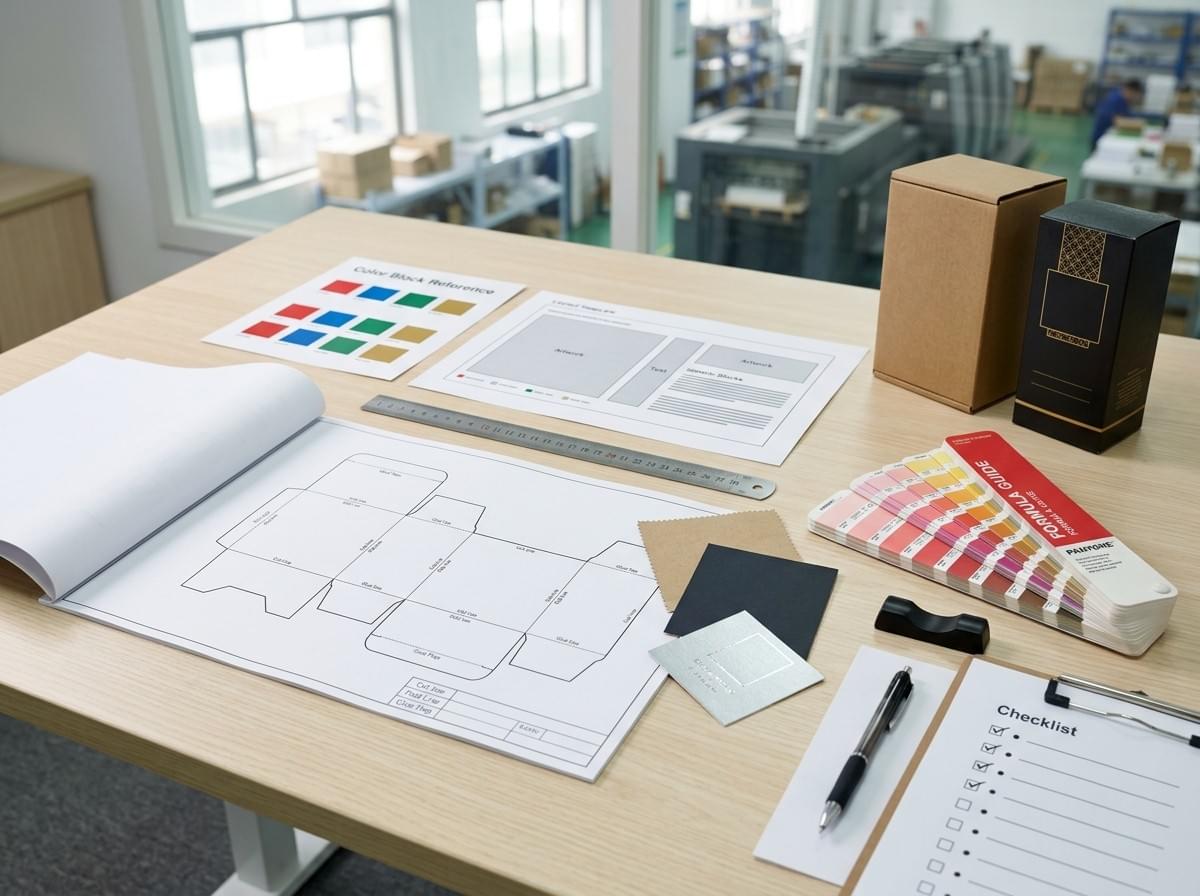
Before sampling, the artwork file should be final and production-ready.
Please check whether the file includes:
- Correct box dieline
- Final logo
- Final text
- Final colors
- Correct front, back, side, lid, base, and insert layout
- Clear bleed area
- Clear cutting line
- Clear folding line
- Clear finishing marks
For custom rigid boxes, drawer boxes, lid and base boxes, and handmade gift boxes, the artwork may include both outer wrapping paper and inner structure details. These should be checked together.
If the artwork is still only a reference design, the sample result may not represent the final production result.
2. Convert Fonts to Outlines or Provide Font Files
Missing fonts are a common artwork problem.
If the supplier does not have the same fonts, the text may change automatically when the file is opened. This can affect spacing, layout, logo balance, and brand appearance.
Before sending final artwork, ask the designer to:
- Convert all text to outlines / curves
- Or package the artwork with all font files
- Or clearly approve any replacement fonts
For packaging production, converting text to outlines is usually the safest option.
This is especially important for brand names, product names, ingredient lists, warning text, barcode areas, and small printed details.
3. Confirm Logo Size and Position
The logo should not only look correct on screen. It should also look balanced on the actual box.
Before sample approval, check:
- Logo size
- Logo position
- Distance from box edge
- Alignment with the center line
- Position on the lid, front panel, sleeve, or drawer pull area
- Whether the logo overlaps with folding, cutting, or opening areas
For premium boxes, a small logo with accurate placement often looks better than an oversized logo.
For retail packaging, the logo may need to be more visible from the front view or shelf angle.
4. Confirm Color Standard
Color should be confirmed before sampling, especially when brand color accuracy is important.
Buyers should confirm whether the artwork uses:
- CMYK printing
- Pantone color
- Black and white printing
- Metallic color
- Full-color artwork
- Special background color
If a brand has strict color requirements, Pantone color reference is recommended.
Please note that colors may look different on screen, paper, coated paper, kraft paper, textured paper, and laminated surfaces.
For this reason, color should be checked with the actual material and surface treatment, not only from a digital preview.
5. Confirm Material and Surface Texture
Printing and finishing results depend heavily on the material surface.
Before approving a sample, confirm:
- Paper type
- Paper thickness
- Wrapped paper texture
- Coated or uncoated surface
- Kraft paper color
- Specialty paper texture
- Inner paper color
- Insert material
- Lamination or varnish type
For example, the same logo may look sharper on coated paper but softer on textured paper. A dark matte surface may also show fingerprints or rubbing marks more easily.
If the project uses textured paper, dark paper, or natural paper, sample confirmation is especially important.
6. Confirm Foil Stamping Area
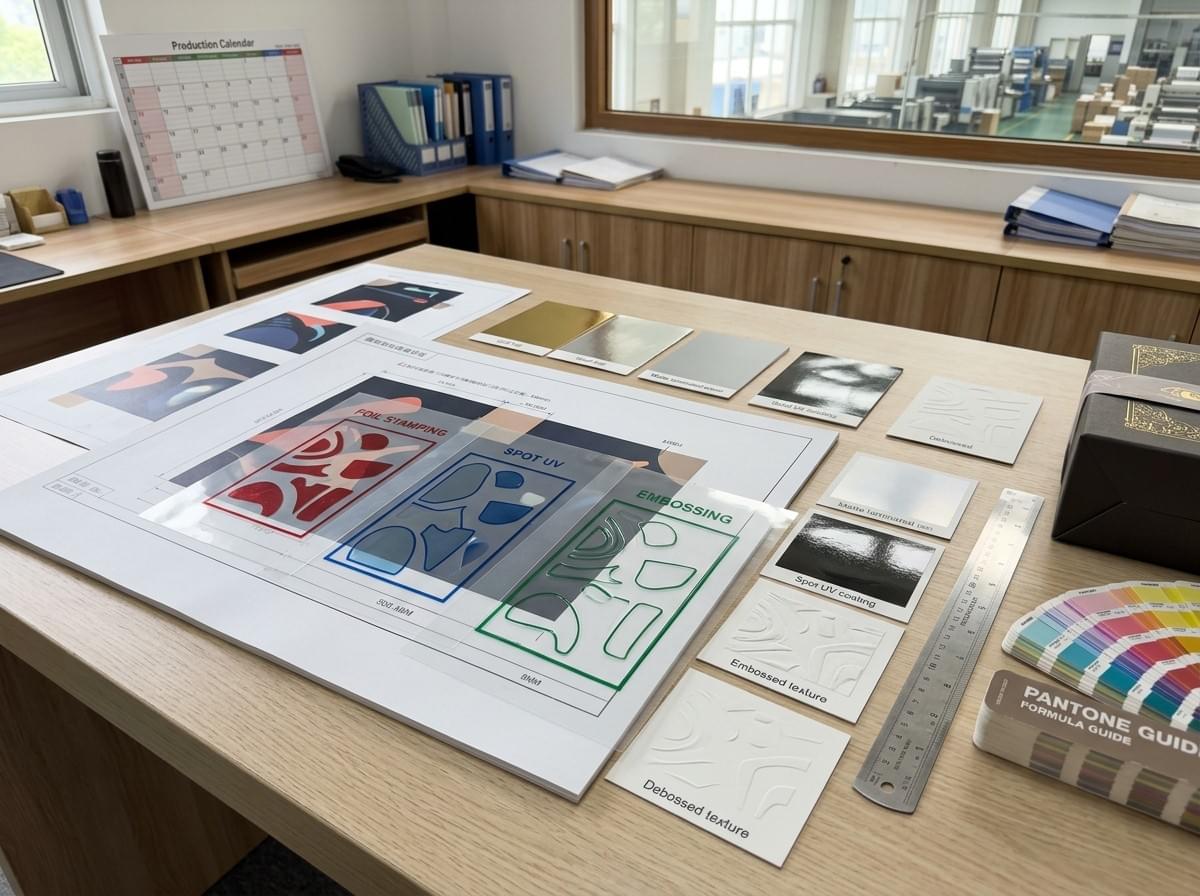
Foil stamping should be clearly marked in the artwork.
Before sample approval, confirm:
- Foil color
- Foil position
- Foil size
- Logo or text area
- Whether foil is on the lid, sleeve, drawer front, or side panel
- Whether the foil area is too large
- Whether thin lines or small text can be produced clearly
Common foil colors include gold, silver, rose gold, copper, black, and holographic foil.
For most packaging projects, foil stamping works best when used on selected details, such as the logo, brand name, border, or small decorative pattern.
Large foil areas may increase cost and production difficulty.
7. Confirm Spot UV Area
Spot UV should also be marked clearly in the artwork.
Before sampling, check:
- Spot UV position
- Spot UV artwork layer
- Whether the spot UV area aligns with printed graphics
- Whether the design uses thin lines or very small details
- Whether the spot UV is used on a matte or soft-touch surface
- Whether the gloss contrast is visible enough
Spot UV is often used for logos, product names, icons, patterns, or selected graphic details.
It is important to confirm alignment during sampling because spot UV needs accurate registration with the printed design.
8. Confirm Embossing or Debossing Details
Embossing and debossing are tactile finishing options.
Before sample approval, confirm:
- Embossed or debossed area
- Logo size
- Pattern detail
- Depth expectation
- Material suitability
- Whether the effect is combined with foil stamping
- Whether the result should be subtle or more visible
Very small text, thin lines, or complex patterns may not be suitable for deep embossing or debossing.
If the packaging uses thick rigid board, wrapped paper, or handmade box structure, the final effect should be checked with a physical sample.
9. Confirm Insert Fit and Product Position
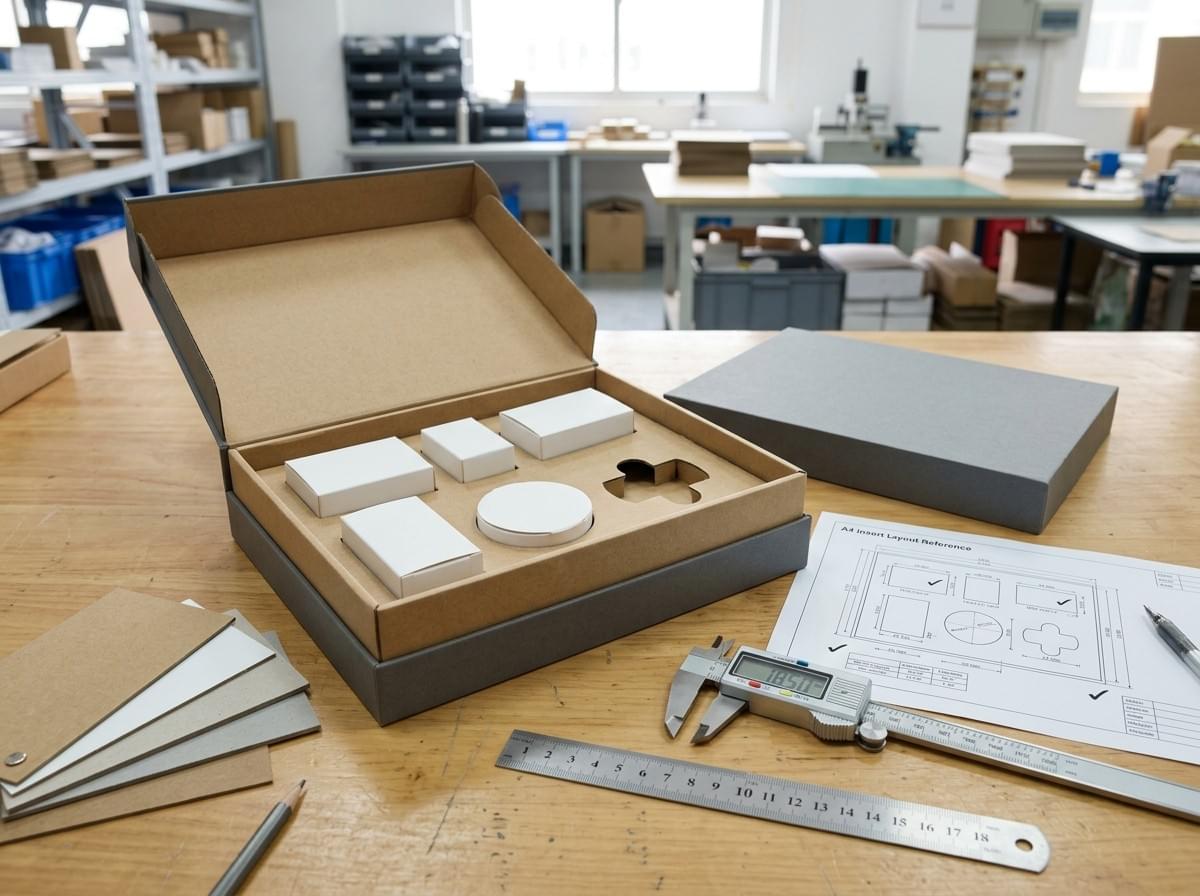
If the box includes an insert, the insert should be checked together with the outer box.
Before approval, confirm:
- Product size
- Insert material
- Insert hole size
- Product placement
- Finger notch position
- Protection requirement
- Product removal experience
- Logo direction when the box is opened
Common insert materials include paperboard, EVA, foam, velvet, molded pulp, and plastic tray.
For cosmetics, fragrance, electronics, jewelry, candles, and gift sets, the insert directly affects both protection and presentation.
A box may look correct from the outside but still fail if the product does not sit properly inside.
10. Confirm Opening Direction and User Experience
Packaging should be checked from the customer’s opening experience.
Before approving the sample, confirm:
- Which side opens first
- Whether the logo faces the correct direction
- Whether the product is presented correctly after opening
- Whether drawer boxes slide smoothly
- Whether lid and base boxes open with suitable tightness
- Whether magnetic boxes close properly
- Whether sleeves are too tight or too loose
This step is easy to miss when checking only flat artwork.
For drawer boxes, lid and base boxes, handmade boxes, and gift boxes, opening direction is especially important.
11. Confirm Barcode, QR Code, and Small Text
Small printed details should be checked carefully before production.
Please confirm:
- Barcode position
- QR code size
- QR code scannability
- Warning text
- Product information
- Legal text
- Ingredients or specification text
- Country of origin
- Recycling marks
- Certification marks
Small text may look clear on screen but become difficult to read after printing, lamination, or surface treatment.
Before mass production, all important small text should be checked on the physical sample.
12. Confirm Quantity and Design Versions
If your project includes several designs, confirm the quantity for each version.
For example:
- 1 design × 1,000 pcs
- 3 designs × 500 pcs each
- 4 SKUs with the same box size but different artwork
- Same structure with different logo colors
- Same outer box with different inserts
This matters because different designs may require separate printing setup, plates, finishing alignment, and packing arrangements.
If some designs share the same structure, material, or insert, this should also be confirmed to reduce confusion and improve production efficiency.
13. Final Checklist Before Sample Approval
Before approving the sample, use this checklist:
| Item | What to Confirm |
|---|---|
| Artwork file | Final dieline, layout, bleed, cutting and folding lines |
| Fonts | Text converted to outlines or font files provided |
| Logo | Size, position, direction, and alignment |
| Color | CMYK, Pantone, material effect, and printed result |
| Material | Paper type, thickness, texture, inner and outer paper |
| Surface treatment | Matte, gloss, soft-touch, varnish, or other base finish |
| Foil stamping | Color, area, position, and artwork layer |
| Spot UV | Position, gloss contrast, and alignment |
| Embossing / debossing | Area, depth, detail, and material suitability |
| Insert | Product fit, layout, protection, and removal experience |
| Opening direction | Correct user experience and logo direction |
| Small text | Barcode, QR code, warning text, and product information |
| Quantity | Quantity per design and SKU version |
| Packing | Export carton, shipping marks, and delivery requirements |
What to Send Your Supplier Before Sampling
To make the sampling process faster, prepare the following files and information:
- Final artwork file
- Box dieline
- Logo file
- Font files or outlined text
- Pantone color code if needed
- Material reference
- Surface finishing requirement
- Product dimensions
- Insert layout if needed
- Quantity per design
- Reference photos
- Packing or shipping requirement
The clearer the information is before sampling, the lower the risk of repeated revisions.
Need a Quick Artwork Check Before Sampling?
If you are not sure whether your artwork, logo placement, color, material, or finishing details are ready for sampling, you can send us your design file and packaging requirements for a quick review.
We can help check the key details before sample making, including printing setup, missing fonts, foil stamping area, spot UV position, embossing effect, insert fit, and box structure.
Frequently Asked Questions
Should I approve packaging production based only on digital artwork?
No. Digital artwork is important, but it cannot fully show color, texture, foil effect, spot UV contrast, embossing depth, or actual product fit. A physical sample is recommended before mass production.
What is the safest way to avoid missing font problems?
The safest way is to convert all text to outlines / curves before sending the final artwork file. If this is not possible, provide the font files or approve replacement fonts before sampling.
Why does the printed color look different from my screen?
Screen colors are displayed with light, while printed colors depend on ink, paper, material surface, lamination, and lighting. For strict brand colors, Pantone reference and physical sample confirmation are recommended.
Can foil stamping and spot UV be used together?
Yes, but they should be used carefully. Too many finishing effects may increase cost and production risk. It is better to keep the design clean and use each effect only where it improves the final presentation.
What should I check on a packaging sample?
Check the structure, size, opening direction, material, color, logo position, finishing effect, insert fit, barcode, small text, and overall presentation before approving production.
Conclusion
A good packaging sample should confirm more than the box shape.
Before approving a sample, buyers should carefully check artwork, fonts, color, logo position, material, texture, foil stamping, spot UV, embossing, insert fit, and opening direction.
These details may look small, but they directly affect final packaging quality, production accuracy, and delivery efficiency.
QX Packs supports custom rigid boxes, handmade gift boxes, folding boxes, drawer boxes, lid and base boxes, packaging sleeves, display boxes, and custom inserts. We help global brands check printing and finishing details before sampling and production.
Need help reviewing your packaging artwork before sampling?
Send us your design file, box size, quantity, material request, finishing details, and reference photos. QX Packs can help check the key printing and finishing details before sample making and suggest a practical production solution.