How a Custom Packaging Project Works: From WhatsApp Inquiry to Sample and Mass Production
Starting a custom packaging project is easier when the first information is clear.
Many buyers contact a packaging supplier through WhatsApp with only one short message:
“How much for this box?”
This is common, but it is usually not enough to start an accurate quotation.
For custom packaging, the supplier needs to understand the product, box type, size, material, insert, printing, finishing, quantity, and delivery needs before giving a useful suggestion.
This guide explains how a custom packaging project usually works with QX Packs, from WhatsApp inquiry to structure suggestion, quotation, sample approval, mass production, quality control, and shipment.
It is written for buyers who want to start a custom box project more efficiently and avoid repeated back-and-forth communication.
Quick Answer
To start a custom packaging project, send these details through WhatsApp:
- Product photo
- Product size and weight
- Box type or reference photo
- Required quantity
- Insert requirement
- Logo or artwork file
- Material or finishing preference
- Target market
- Shipping destination
- Expected timeline
If you are not sure about the box structure, send product photos, size, quantity, and reference packaging first. QX Packs can review the project and suggest a practical packaging direction before quotation.
Custom Packaging Project Workflow
| Step | What Happens | Buyer Should Prepare |
|---|---|---|
| 1 | WhatsApp inquiry | Product photos |
| 2 | Requirement check | Size and quantity |
| 3 | Structure suggestion | Box reference |
| 4 | Quotation | Material and finish |
| 5 | Sample confirmation | Logo and artwork |
| 6 | Sample review | Fit and appearance |
| 7 | Mass production | Final approval |
| 8 | Quality control | Packing requirements |
| 9 | Shipment | Delivery address |
Step 1: Send the First WhatsApp Inquiry
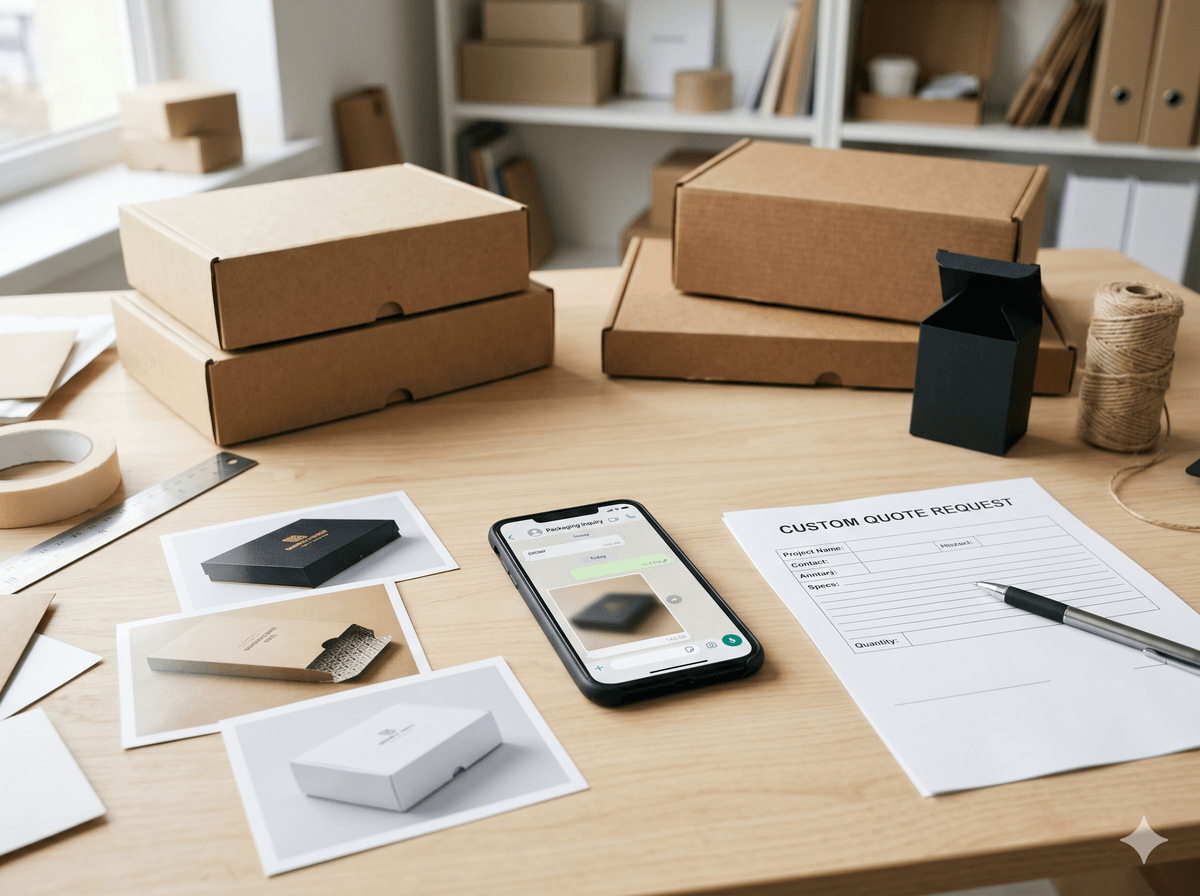
The first message does not need to be perfect.
But it should give enough information for the supplier to understand what kind of packaging you need.
A useful first message includes:
- Product type
- Product photo
- Product size
- Quantity
- Box style preference
- Reference image
- Destination country
For example:
“Hi QX Packs, I need custom packaging for a skincare gift set. Product size is 120 × 80 × 35 mm. Quantity is 1,000 pcs. I prefer a rigid box with insert. Please help suggest the box structure and quote direction.”
This kind of message is much more useful than only asking, “How much?”
It helps the supplier quickly judge whether the project needs a rigid box, folding carton, drawer box, lid and base box, sleeve, blister tray, paper insert, EVA insert, molded pulp insert, or another structure.
Step 2: Share Product Photos and Dimensions
Product photos and dimensions are the foundation of a custom packaging project.
Without them, the supplier can only guess the box size and structure.
Send clear photos from different angles:
- Front view
- Side view
- Top view
- Full set view
- Accessories included
- Any fragile or heavy parts
- Existing packaging if available
Also send product dimensions:
- Length
- Width
- Height
- Weight
- Quantity per box
For product kits, place all items on a table and take a clear photo. This helps the supplier understand the layout.
For fragile products such as glass bottles, candles, chocolate, cosmetics, electronics accessories, or jewelry, product weight and protection needs should be shared early.
Step 3: Confirm the Packaging Goal
Before choosing the box, confirm the main purpose of the packaging.
Different packaging goals lead to different structures.
The goal may be:
- Retail display
- Online shipping
- Gift presentation
- Product protection
- Premium unboxing
- Low-cost launch
- Influencer or PR kit
- Wholesale packaging
- Subscription box
- Shelf-ready packaging
For example, a product sold online may need stronger protection.
A retail product may need clearer branding and shelf visibility.
A gift set may need a better opening experience.
A fragile glass bottle may need a stronger insert.
The same product can use different packaging depending on how it is sold.
Step 4: Choose a Box Structure Direction
After reviewing the product and packaging goal, the next step is choosing a box structure direction.
Common custom packaging structures include:
- Custom rigid boxes
- Handmade gift boxes
- Custom folding boxes
- Drawer style boxes
- Lid and base boxes
- Packaging sleeves
- Display boxes
- Custom inserts
The buyer does not need to know every technical detail.
A reference photo is often enough to start.
For premium jewelry, fragrance, cosmetics, and gift sets, rigid boxes or handmade gift boxes may be suitable.
For retail products and higher-volume packaging, folding boxes or sleeves may be more practical.
For product kits, inserts, trays, dividers, or blister trays may be needed.
The box structure should be chosen based on product size, protection needs, budget, and presentation level.
Step 5: Discuss Insert and Protection Needs
If the product needs to stay in place, the insert should be planned together with the box.
Do not treat the insert as a last-minute detail.
Common insert options include:
- EVA foam insert
- Foam insert
- Velvet insert
- Paperboard insert
- Molded pulp insert
- Blister tray
- Paper divider
- Fabric-covered tray
The right insert depends on product weight, shape, surface sensitivity, and shipping risk.
For a glass bottle, the insert may need to hold the body and neck area.
For chocolate, the tray should hold each piece cleanly.
For electronics accessories, the tray should organize the product, cable, manual, and hanging display needs.
For jewelry, the insert should control the chain, ring slot, bracelet support, or watch position.
If the product is fragile, send the protection requirements through WhatsApp before quotation.
Step 6: Confirm Material and Finishing Direction
Material and finishing affect both appearance and cost.
Common material choices include:
- Grey board
- Paperboard
- Coated paper
- Kraft paper
- Textured paper
- Specialty paper
- Corrugated board
Common finishing options include:
- Matte lamination
- Gloss lamination
- Soft-touch lamination
- Foil stamping
- Embossing
- Debossing
- Spot UV
- Die-cut window
- Ribbon pull
- Magnetic closure
You do not need to decide everything at the beginning.
If you are not sure, send reference photos and explain what you like about them.
For example:
“I like the black textured paper.”
“I want a gold foil logo.”
“I want the box to look premium but not too expensive.”
“I need a simple structure for retail display.”
Clear material and finish direction helps the supplier provide a more accurate quote.
Step 7: Receive Structure Suggestion and Quotation
After the basic information is clear, QX Packs can review the project and suggest a packaging direction.
The quotation usually depends on:
- Box type
- Box size
- Material
- Insert type
- Printing method
- Finishing process
- Order quantity
- Handwork complexity
- Packing method
- Shipping requirement
If some information is missing, the quotation may only be an estimate.
A clearer specification leads to a clearer quote.
This is why product size, quantity, reference photos, and insert needs should be shared early.
Step 8: Confirm Artwork and Logo Files
Before sampling, artwork and logo files should be checked.
For logo printing, foil stamping, embossing, debossing, and spot UV, vector artwork is usually preferred.
Useful file formats include:
- AI
- SVG
- EPS
High-resolution PNG or JPG files may be used for early discussion, but final production usually needs clearer artwork.
Before sampling, confirm:
- Logo position
- Logo size
- Logo color
- Printing method
- Foil color
- Inner printing
- Box surface design
- Barcode or label position if needed
If the artwork is not ready, sampling may be delayed.
Step 9: Make a Sample for Review
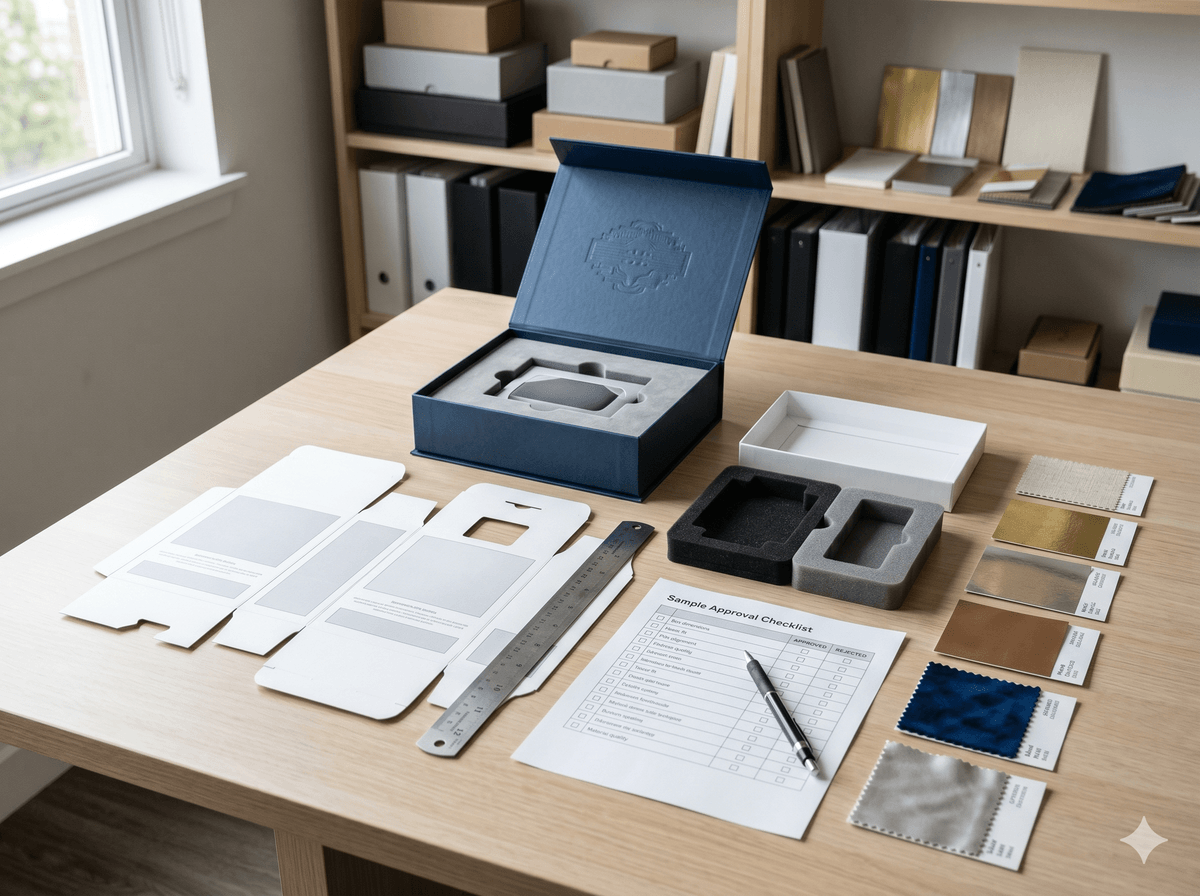
The sample is used to check structure, size, material, printing effect, insert fit, and overall presentation.
For custom packaging, the sample should answer practical questions:
- Does the product fit correctly?
- Is the box easy to open?
- Does the insert hold the product?
- Is the product easy to remove?
- Does the logo position look right?
- Is the material direction suitable?
- Does the box close properly?
- Does the packaging match the brand level?
If the sample is for a product kit, check every product position carefully.
If the sample is for a fragile product, check whether the insert support is enough.
The goal is not only to make the sample look good. The goal is to confirm that the structure can work before mass production.
Step 10: Review and Approve the Sample
After receiving the sample, the buyer should review it carefully.
Check:
- Size
- Structure
- Color
- Material
- Logo
- Finishing
- Insert fit
- Product placement
- Opening experience
- Packing method
If changes are needed, mark them clearly with photos or notes.
For example:
“Please make the cavity 2 mm wider.”
“Move the logo 10 mm higher.”
“Use softer insert material.”
“Change the paper to a darker black.”
“Make the drawer pull easier to use.”
Clear feedback reduces revision time.
Do not approve the sample if the product does not fit correctly.
Sample approval is the bridge between development and production.
Step 11: Start Mass Production
After sample approval, mass production can begin.
Before production starts, the final details should be confirmed:
- Final box size
- Final material
- Final artwork
- Final insert layout
- Final quantity
- Final finishing
- Carton packing method
- Delivery destination
- Production timeline
Mass production should follow the approved sample as the standard.
If the buyer changes material, size, color, or structure after approval, the quote and timeline may need to be updated.
Step 12: Quality Control and Packing
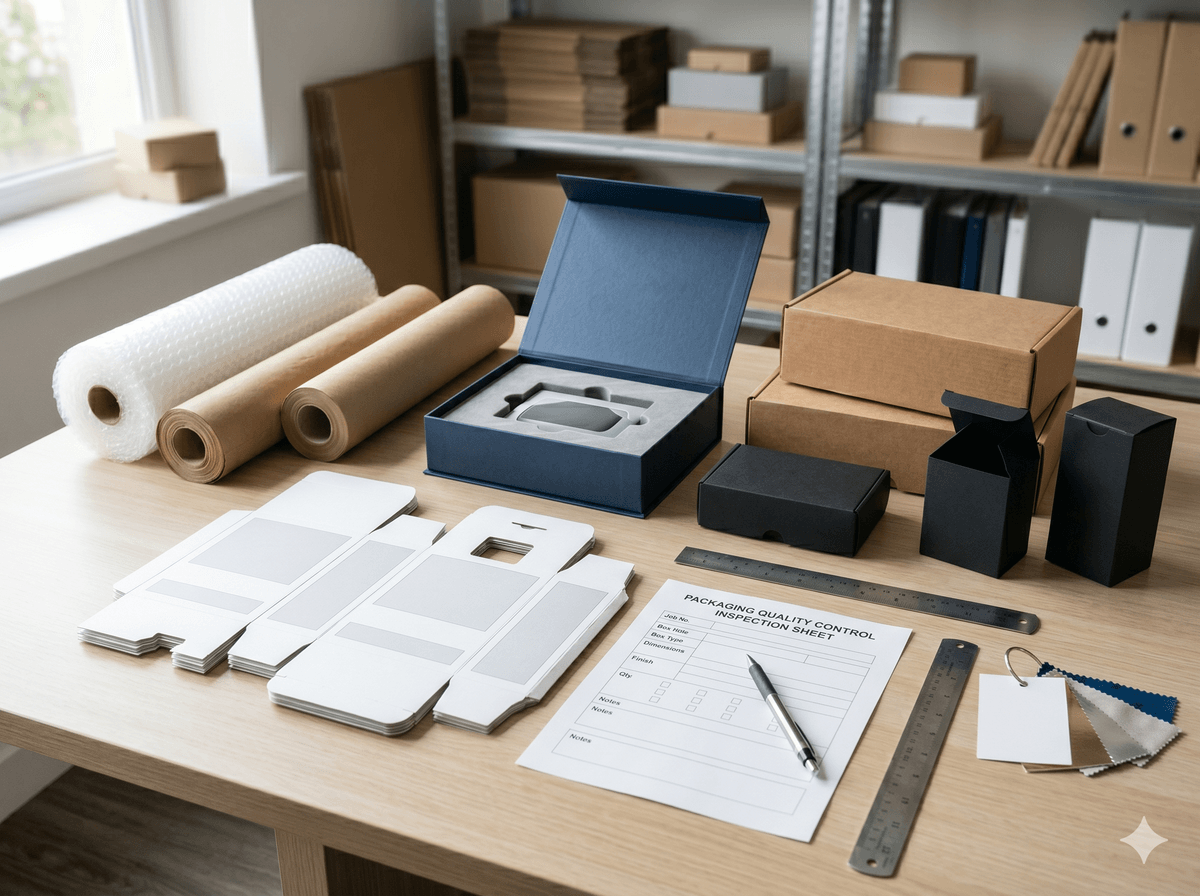
Quality control is important for custom packaging because many details affect the final result.
QX Packs checks packaging details such as:
- Box structure
- Surface paper
- Printing quality
- Logo position
- Foil or embossing effect
- Folding and gluing
- Insert fit
- Box opening and closing
- Carton packing
- Overall appearance
For rigid boxes, handmade boxes, and drawer boxes, assembly and surface details should be checked carefully.
For folding boxes, die-cutting, folding lines, printing, and gluing need attention.
For inserts, cavity size and product fit are important.
Packing should also protect the boxes during shipment.
Step 13: Shipment and Follow-Up
After production and packing, shipment can be arranged based on the buyer’s destination and delivery needs.
Common delivery information includes:
- Destination country
- Delivery address
- Shipping method
- Carton quantity
- Label requirement
- Warehouse or 3PL details
- Special packing instruction
After shipment, good follow-up helps the buyer confirm receiving status and plan future reorders.
For repeat orders, keeping the approved specification and sample record can save time.
What Buyers Should Prepare Before Contacting QX Packs
Prepare these details before sending a WhatsApp inquiry:
- Product photos
- Product size
- Product weight
- Quantity per box
- Box style preference
- Insert requirement
- Logo file
- Reference photo
- Order quantity
- Material preference
- Finishing preference
- Destination country
- Target launch date
You do not need to prepare everything perfectly.
But the more complete the first message is, the faster the project can move forward.
Example WhatsApp Message
You can copy and edit this message:
“Hi QX Packs, I need custom packaging for my product. Product photos are attached. Product size is [length × width × height], weight is [weight], quantity is [order quantity], and destination is [country]. I prefer [rigid box / folding box / drawer box / lid and base box] with [EVA / paperboard / molded pulp / blister tray] insert. Please help suggest a suitable structure and quote direction.”
If you are not sure about the box type, you can write:
“Hi QX Packs, I am not sure which packaging structure is best. I attached product photos, size, quantity, and reference images. Please help suggest a practical packaging solution.”
Common Mistakes That Slow Down a Packaging Project
Sending Only One Product Photo
One photo is often not enough.
Send photos from different angles and include all accessories.
Asking for a Final Price Too Early
If size, structure, material, insert, and quantity are not clear, the price can only be estimated.
Choosing a Box Style Before Checking Product Fit
A box can look good in a reference photo but may not fit your product.
Product size and insert layout should be checked first.
Ignoring Insert and Protection Needs
For fragile products, the insert is part of the packaging structure.
Do not leave it until the end.
Sending Low-Resolution Logo Files
Low-quality logo files can delay sampling and affect printing or foil stamping.
Approving a Sample Too Quickly
If the product does not fit correctly, do not approve the sample.
Fix the issue before mass production.
How
QX Packs Supports Custom Packaging Projects
QX Packs supports custom packaging projects from structure discussion to sampling and production follow-up.
Our team can help with:
- Box structure suggestions
- Material and finishing options
- Insert material comparison
- Sample development
- Artwork checking
- Production follow-up
- Quality control
- Carton packing support
- Shipment coordination
QX Packs manufactures custom rigid boxes, handmade gift boxes, folding boxes, drawer boxes, lid and base boxes, display boxes, packaging sleeves, and custom inserts.
Since 2004, QX Packs has supported global brands with custom packaging manufacturing, sample support, flexible customization, and reliable production follow-up.
Conclusion
A custom packaging project works better when the first inquiry includes clear product information.
Start with product photos, size, weight, quantity, box style preference, insert needs, logo file, reference photos, and destination country.
QX Packs can then review the project, suggest a suitable structure, prepare a quotation, support sampling, and follow up through mass production and shipment.
If you are ready to start a packaging project, send your product details through WhatsApp. A clear first message can save time, reduce misunderstanding, and help move the project toward sample approval faster.
Start Your Custom Packaging Project
Send your box type, product photos, size, quantity, insert needs, logo file, and destination country through WhatsApp.
QX Packs can review your project and suggest the next step before sampling.
FAQ
Q1: What information should I send for a custom packaging quote?
Send product photos, product size, product weight, box style preference, insert needs, logo file, quantity, reference photos, and destination country.
Q2: Can I start a packaging project if I do not know the box type?
Yes. Send product photos, size, quantity, and reference packaging images. QX Packs can suggest a suitable box structure and insert direction.
Q3: Do I need artwork before requesting a quote?
Not always. You can start with product details and reference photos. Final artwork is needed before sampling or production.
Q4: What file format is best for logo printing?
AI, PDF, SVG, or EPS files are preferred. High-resolution PNG or JPG files may be used for early discussion.
Q5: Why is a sample important before mass production?
A sample helps confirm box size, structure, material, logo position, insert fit, and overall presentation before production.
Q6: Can QX Packs support both sample and mass production?
Yes. QX Packs supports structure discussion, sample development, production follow-up, quality control, packing, and shipment support for custom packaging projects.