Packaging Cushion Materials: EVA Foam vs. Molded Pulp vs. Paperboard Dividers
When a product is fragile, heavy, or easily scratched, the insert is not only for display.
It becomes part of the protection system.
The outer box protects the product from outside pressure. The cushion material inside the box controls movement, absorbs impact, separates parts, and keeps the product in the correct position during shipping and handling.
For custom packaging projects, buyers often ask:
“Should I use EVA foam, molded pulp, paperboard dividers, or a blister tray?”
The answer depends on product weight, shape, surface sensitivity, display needs, shipping method, budget, and brand positioning.
This guide compares common packaging cushion materials and explains when to use each option for glass bottles, chocolate, electronics accessories, jewelry, cosmetics, gift sets, and other fragile products.
Quick Answer
Choose EVA foam when the product needs a precise fit, strong support, and a premium internal structure.
Choose molded pulp when the product needs cushioning with a more paper-based material direction.
Choose paperboard dividers when the product needs separation, light protection, and better cost control.
Choose blister trays when the product needs clear product positioning, molded cavities, and retail or product-kit organization.
The best option is not always the softest material. It is the material that fits the product weight, cavity depth, shipping risk, and packaging style.
If you are comparing EVA foam, molded pulp, paperboard dividers, or blister trays, you can also review our Custom Inserts page for more packaging insert options.
Packaging Cushion Material Comparison
| Material | Best For | Main Strength |
|---|---|---|
| EVA foam | Heavy or premium items | Precise fit |
| Molded pulp | Fragile products | Cushioning support |
| Paperboard dividers | Light product sets | Cost control |
| Blister trays | Shaped product kits | Clean positioning |
| Foam insert | General protection | Shock absorption |
Why Cushion Material Matters in Custom Packaging
Many packaging problems happen because the outer box looks good, but the product moves inside.
Common problems include:
- Bottles shaking inside the box
- Glass items touching each other
- Chocolate pieces moving out of position
- Electronics accessories sliding during shipping
- Jewelry chains tangling
- Product sets looking messy after transport
- Inserts collapsing under product weight
- Customers receiving packaging that feels unfinished
Good cushion design should control three things:
- Product position
- Product movement
- Product removal
The product should stay secure during transport, look clean when opened, and be easy for the customer to take out.
EVA Foam Inserts
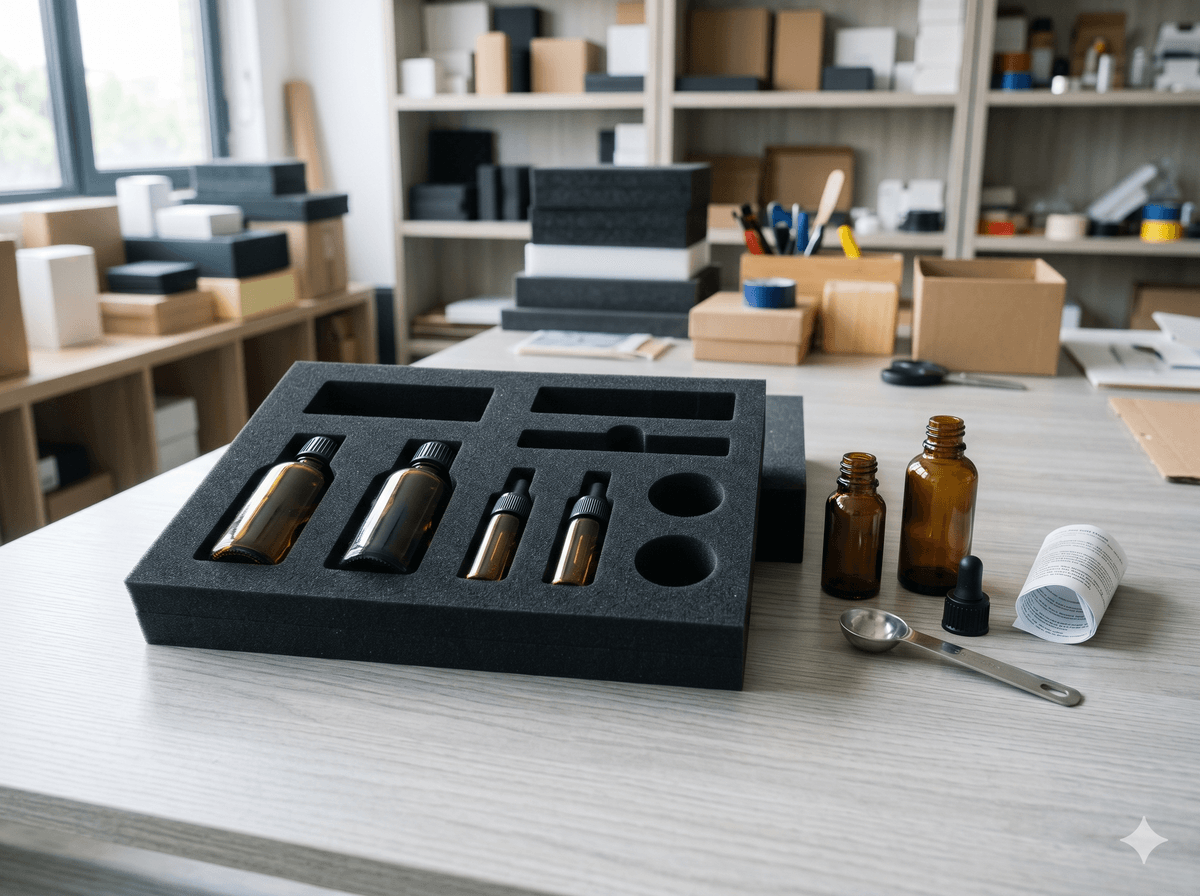
EVA foam is one of the most common materials for custom protective inserts.
It is often used when the product needs a precise cavity, firm support, and a cleaner premium presentation.
EVA can be cut into different shapes based on product size and layout. It can also be combined with velvet, fabric, or paper covering for a more refined look.
EVA foam is commonly used for:
- Glass bottles
- Jewelry sets
- Watches
- Electronics accessories
- Premium gift sets
- Tools or small devices
- Cosmetic bottles
- Fragile product kits
EVA is suitable when the product needs to stay firmly in place.
For example, if a glass bottle is placed inside a rigid box, EVA can hold the bottle body and neck area more securely. If several small products are packed together, EVA can create separate cavities and keep the layout clean.
When Should You Use EVA Foam?
Use EVA foam when protection and product positioning are more important than the lowest cost.
EVA foam works well when:
- The product is heavy
- The product is fragile
- The product needs a tight cavity
- The product must not move inside the box
- The packaging is premium
- The product is part of a gift set
- The box uses a rigid structure
- The customer expects a clean opening presentation
EVA is often a strong choice for custom rigid boxes because the outer box and insert can be designed together.
For premium glass bottles, jewelry boxes, electronics kits, and high-value gift sets, EVA can help the product feel more stable and more finished.
Limitations of EVA Foam
EVA is useful, but it is not always the best answer.
Before choosing EVA, consider:
- Higher cost than simple paperboard
- More material thickness
- Less suitable for very low-cost packaging
- May require accurate product measurements
- Tight cavities need testing before production
- Deep cavities may affect product removal
If the cavity is too tight, the product may be difficult to remove.
If the cavity is too loose, the product may still move.
EVA works best when product size, weight, and layout are confirmed before sampling.
Molded Pulp Inserts
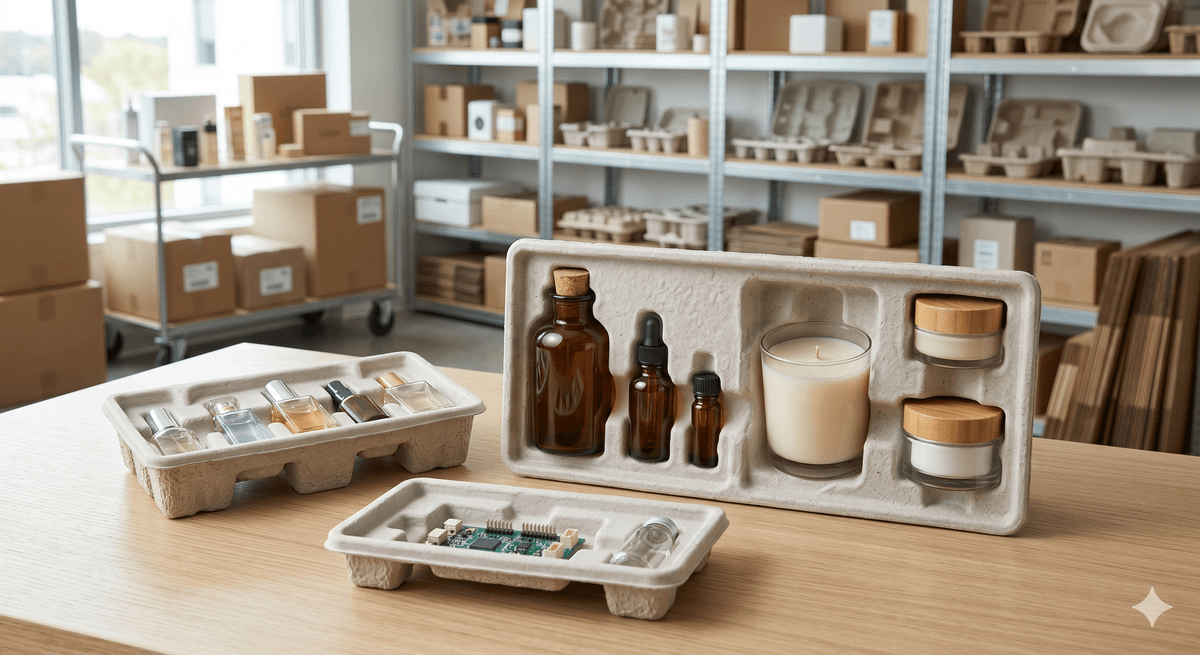
Molded pulp is a paper-based molded insert material.
It is often used when brands want cushioning support with a more natural material appearance.
Molded pulp can be shaped to hold bottles, jars, electronics, candles, gift items, and fragile products.
It is commonly used for:
- Glass bottles
- Cosmetic jars
- Candles
- Fragrance bottles
- Home décor items
- Electronics accessories
- Gift sets
- Fragile retail products
Molded pulp can provide shock absorption and product separation.
It also works well when the packaging direction needs to feel more paper-based or recyclable.
However, molded pulp should be discussed carefully. Material finish, color, surface texture, tolerance, and mold cost can all affect the final result.
When Should You Use Molded Pulp?
Use molded pulp when the product needs cushioning support and the brand prefers a paper-based insert direction.
Molded pulp works well when:
- The product is fragile
- The product needs shaped support
- The brand prefers less plastic
- The product is packed in a box or sleeve
- The packaging style can accept a natural texture
- The order quantity supports mold development
- The product shape is stable and confirmed
For glass bottles or candles, molded pulp can help keep the product separated from the outer box wall.
For gift sets, molded pulp can hold several items in one tray while reducing movement during shipping.
Limitations of Molded Pulp
Molded pulp is not always suitable for every premium packaging project.
Before choosing molded pulp, consider:
- Mold cost
- Minimum quantity
- Surface texture
- Color consistency
- Dimensional tolerance
- Product removal space
- Moisture sensitivity
- Visual style compatibility
If the product requires a very smooth, luxury interior, molded pulp may not match the expected look.
If the product cavity must be extremely precise, EVA or blister tray may be easier to control.
Molded pulp is practical, but it should be chosen based on product and brand direction, not only because it sounds more sustainable.
Paperboard Dividers
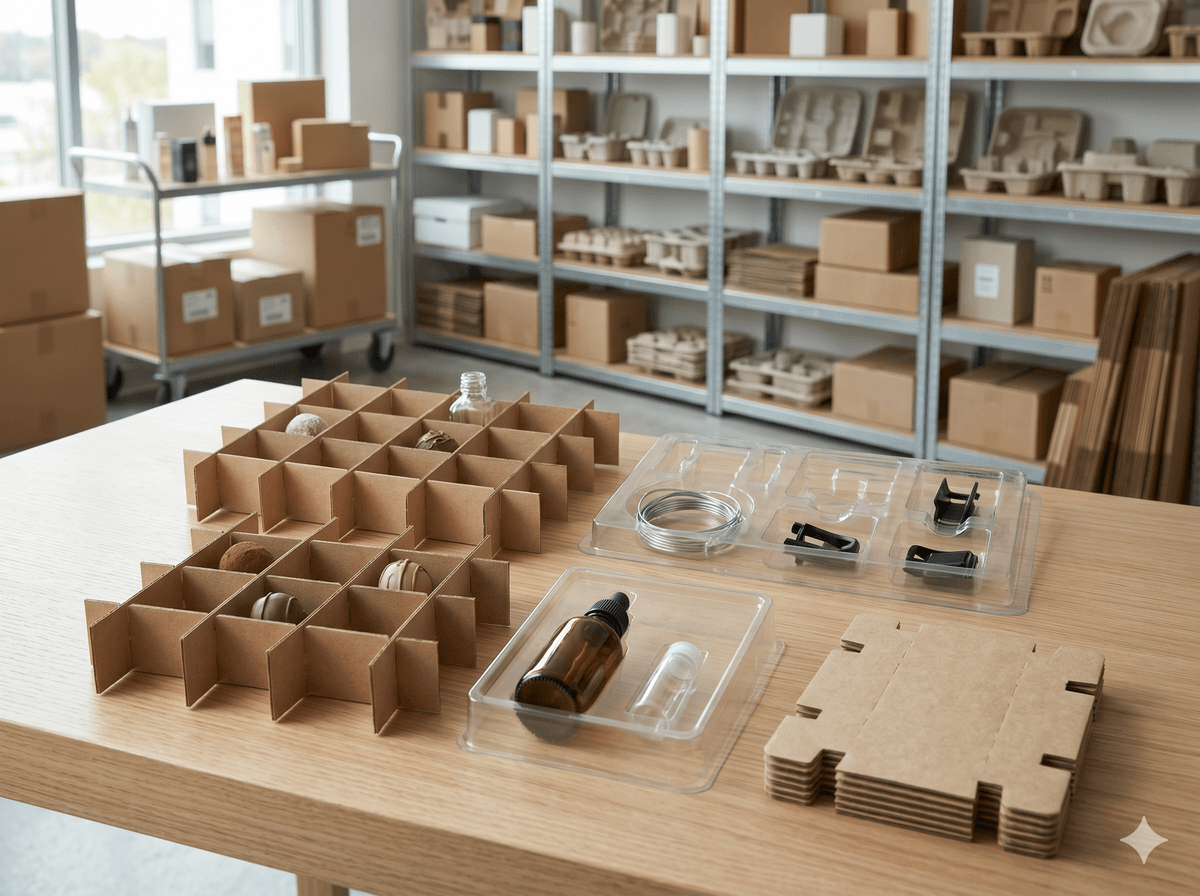
Paperboard dividers are a practical insert solution for separating products inside a box.
They are often used for lightweight products, product sets, chocolate boxes, small accessories, cosmetics, tea, candles, and gift packaging.
Paperboard dividers can be folded, slotted, printed, or covered depending on the design.
They are commonly used for:
- Chocolate packaging
- Small bottle sets
- Tea or food gift sets
- Lightweight cosmetics
- Candles
- Accessories
- Promotional kits
- Retail product bundles
Paperboard dividers are especially useful when the goal is separation rather than deep cushioning.
For example, chocolate pieces may need a paper tray, liner, or divider to keep each piece in position. Small bottles may need paperboard partitions to prevent direct contact.
When Should You Use Paperboard Dividers?
Use paperboard dividers when the product is relatively light and does not require deep shock absorption.
Paperboard dividers work well when:
- The product needs separation
- The product is not too heavy
- Cost control is important
- The packaging is paper-based
- The product set needs clean organization
- The box is for retail or gift presentation
- The insert does not need a deep molded cavity
For chocolate packaging, paperboard dividers can help organize pieces and improve presentation.
For small accessories or cosmetics, dividers can keep products from touching each other while keeping the packaging cost under control.
Limitations of Paperboard Dividers
Paperboard dividers are not a replacement for stronger cushioning.
Before choosing paperboard dividers, consider:
- Limited shock absorption
- Not ideal for heavy glass items alone
- May bend under pressure
- Less suitable for irregular heavy products
- Needs careful slot design
- May require outer carton protection
If the product is fragile, heavy, or high-value, paperboard dividers may need to be combined with EVA, molded pulp, foam, or blister trays.
Blister Trays
Blister trays are plastic molded trays used to hold products in shaped cavities.
They are common in cosmetics, electronics accessories, chocolate, small bottle sets, and retail packaging.
Blister trays can provide clean product positioning and clear cavity structure.
They are commonly used for:
- Cosmetic bottles
- Glass vials
- Electronics accessories
- Charger and cable sets
- Chocolate trays
- Product kits
- Small retail sets
- Sample packaging
Blister trays are useful when product shapes need to be held in specific positions.
For example, small glass bottles can sit in separate cavities. Chocolate pieces can be arranged in a molded tray. Electronics accessories can be displayed in a clean retail layout.
When Should You Use Blister Trays?
Use blister trays when the product needs shaped cavities, clean organization, and a production-friendly layout.
Blister trays work well when:
- The product has repeated shapes
- Several items need to be displayed together
- The tray needs a clean molded look
- Product positioning is important
- The packaging uses a folding box or sleeve
- The project quantity supports tooling
- The product needs retail-ready presentation
Blister trays can be useful for cosmetics, chocolate, electronics accessories, and small product kits.
Limitations of Blister Trays
Blister trays can be practical, but they are not suitable for every brand.
Before choosing blister trays, consider:
- Tooling cost
- Material preference
- Plastic appearance
- Cavity tolerance
- Product surface protection
- Tray thickness
- Shipping test needs
For premium rigid boxes, EVA or fabric-covered inserts may feel more refined.
For paper-based packaging direction, molded pulp or paperboard dividers may be more suitable.
Which Cushion Material Fits Glass Bottles?
Glass bottles need both positioning and impact control.
Common options include:
- EVA foam insert
- Molded pulp insert
- Blister tray
- Paperboard divider with support
- Foam insert
For premium glass bottles in rigid boxes, EVA can provide strong cavity support.
For skincare or fragrance set packaging, molded pulp may work if the brand accepts a paper-based texture.
For small glass vials or product kits, blister trays can provide clean cavity positioning.
If several glass bottles are packed together, avoid allowing the bottles to touch each other.
The insert should separate each item and control movement.
Which Cushion Material Fits Chocolate Packaging?
Chocolate packaging needs clean positioning, presentation, and food-safe material planning.
Common options include:
- Blister tray
- Paperboard tray
- Paperboard divider
- Paper liner
- Sleeve and tray structure
For chocolate boxes, the insert should hold each piece in position without damaging the surface.
A blister tray can create repeated cavities for chocolate pieces.
A paperboard divider can create a more paper-based gift presentation.
A paper sleeve can complete the outer look and support branding.
Material selection for food-related packaging should be confirmed based on the actual product and market requirements.
Which Cushion Material Fits Electronics Accessories?
Electronics accessories packaging often need structure, display, and shipping safety.
Common options include:
- Blister tray
- Paperboard insert
- EVA insert
- Molded pulp insert
- Hanging paper card
- Folding box with inner tray
For chargers, cables, USB accessories, phone cases, batteries, and small electronics, the packaging needs to balance retail display and protection.
A blister tray works well for product positioning.
A paperboard insert works well for cost-controlled retail packaging.
EVA can be used when the product needs premium presentation or stronger support.
Molded pulp can be considered when the brand prefers a molded paper-based direction.
Which Cushion Material Fits Jewelry and Gift Sets?
Jewelry and gift set packagings need protection, but presentation is also important.
Common options include:
- Velvet-covered EVA
- Foam insert
- Paperboard jewelry card
- Fabric-covered tray
- Drawer tray
- Molded pulp for selected gift sets
For necklaces, the insert should control the chain and center the pendant.
For rings, the slot should hold the ring securely.
For bracelets and watches, the insert may need stronger support.
For premium jewelry, EVA or velvet-covered inserts usually provide a cleaner presentation.
For cost-controlled fashion accessories, paperboard cards or dividers may be enough.
How Product Weight Affects Cushion Material
Product weight is one of the most important factors in material selection.
A light product may only need a paperboard insert.
A medium-weight product may need EVA, foam, or a stronger tray.
A heavy glass or metal product may need a deeper cavity and stronger support.
Before choosing the insert, confirm:
- Product weight
- Product height
- Product contact area
- Product center of gravity
- Shipping method
- Box structure
- Removal space
A heavy product should not sit loosely in a shallow insert.
If the insert collapses or shifts, the outer box alone cannot solve the problem.
How Box Structure Affects Cushion Material
The outer box and cushion material should be developed together.
A rigid box can support EVA, foam, velvet inserts, molded pulp, or paperboard trays.
A folding carton often works better with paperboard inserts, blister trays, or lighter molded trays.
A drawer box may require a tray that slides smoothly without catching.
A lid and base box may need enough depth for the insert and product height.
A sleeve structure may work with blister trays, pulp trays, or paperboard trays.
Before sampling, confirm whether the insert height fits the box depth.
The lid should close properly, and the product should not press against the top cover.
Cost Factors for Cushion Materials
Different cushion materials have different cost structures.
Cost may be affected by:
- Material type
- Material thickness
- Product cavity shape
- Tooling or mold cost
- Cutting method
- Covering material
- Order quantity
- Handwork complexity
- Packing method
- Waste and layout efficiency
EVA may cost more than simple paperboard dividers.
Molded pulp and blister trays may require tooling.
Paperboard dividers are often more cost-effective for light products.
A complex cavity layout may cost more even if the material looks simple.
To get a clear quote, send product photos, product size, weight, quantity, box type, and preferred material.
Common Cushion Material Mistakes
Choosing the Material Before Confirming Product Weight
Do not choose an insert only because it looks good.
Product weight affects cavity depth, support strength, and material choice.
Using Paperboard for Heavy Fragile Items Without Support
Paperboard dividers can separate items, but they may not provide enough cushioning for heavy glass products.
Use stronger support when needed.
Making EVA Cavities Too Tight
A tight EVA cavity can hold the product well, but it may make the product difficult to remove.
Leave enough removal space.
Choosing Molded Pulp Without Checking Texture
Molded pulp has a natural texture.
It may not match every premium packaging style.
Ignoring Shipping Tests
If the product is fragile or heavy, test the insert and outer box before mass production.
Do not rely only on appearance.
What to Send Before Asking for an Insert Recommendation
To receive a useful insert suggestion, prepare:
- Product photo
- Product size
- Product weight
- Quantity per box
- Box style
- Protection requirements
- Preferred material
- Shipping destination
- Reference photo
- Order quantity
If you are not sure which cushion material is suitable, send the product details first.
QX Packs can help compare EVA foam, molded pulp, paperboard dividers, blister trays, and other insert options before sampling.
Conclusion
Packaging cushion materials should be selected based on product protection, product weight, display needs, shipping risk, budget, and brand positioning.
EVA foam is strong for precise support and premium presentation.
Molded pulp is useful for shaped cushioning with a paper-based direction.
Paperboard dividers are practical for lightweight separation and cost control.
Blister trays work well for shaped product kits, chocolate, cosmetics, glass vials, and electronics accessories.
There is no single best insert material for every product.
The right choice depends on what the product needs to survive shipping, stay organized, and look ready when opened.
QX Packs manufactures custom inserts, rigid boxes, folding boxes, drawer boxes, lid and base boxes, blister trays, paperboard dividers, EVA foam inserts, molded pulp inserts, and other packaging solutions for global brands.
Since 2004, QX Packs has supported custom packaging projects with structure suggestions, sample development, and production follow-up.
If you are choosing cushion materials for glass bottles, chocolate, electronics accessories, jewelry, cosmetics, or gift sets, send your product size, weight, quantity, protection requirements, and preferred material through WhatsApp. We can help suggest a practical insert direction before sampling.
Need Help Choosing Cushion Materials?
Send your product size, weight, quantity, protection requirements, box style, and preferred insert material through WhatsApp.
QX Packs can help compare EVA foam, molded pulp, paperboard dividers, blister trays, and other custom insert options for your packaging project.
FAQ
Q1: What is the best packaging cushion material for fragile products?
The best material depends on product weight, shape, shipping risk, and packaging style. EVA foam, molded pulp, blister trays, and foam inserts are common options for fragile products.
Q2: Is EVA foam better than molded pulp?
EVA foam is better for precise cavities and premium presentation. Molded pulp is better when the project needs shaped cushioning with a paper-based material direction.
Q3: Are paperboard dividers enough for glass bottles?
Paperboard dividers may work for light bottles or secondary separation, but heavy or fragile glass bottles often need stronger support such as EVA, molded pulp, blister trays, or foam inserts.
Q4: When should I use blister trays?
Blister trays are suitable for cosmetics, chocolate, glass vials, electronics accessories, and product kits that need clean molded cavities and organized product positioning.
Q5: Can QX Packs suggest the right insert material?
Yes. Send product photos, size, weight, quantity per box, box style, and protection requirements. QX Packs can suggest a suitable cushion material before sampling.
Prepare product photos, product dimensions, weight, quantity per box, preferred box style, insert material preference, order quantity, and shipping destination.