
Introduction
Electronics accessories packaging can look simple, but small mistakes before production can create expensive problems later.
For products such as chargers, cables, phone cases, earbuds, USB accessories, batteries, and small electronic parts, packaging must fit the product correctly, support retail display, protect the product during shipping, and carry accurate product information.
Before mass production starts, brands should not only approve the visual design. They should also confirm the product dimensions, inner layout, artwork files, barcode position, labeling information, carton packing, and sample quality.
This checklist helps buyers review the most important packaging details before approving production.
Why a Pre-Production Checklist Matters
Many packaging problems do not happen because the factory cannot produce the box. They happen because key details were not confirmed clearly before production.
Common risks include:
- The product does not fit the insert
- The box is too loose or too tight
- The artwork does not match the dieline
- The barcode is too small or placed incorrectly
- The hanging hole is too weak
- The carton quantity is not efficient
- The label information is incomplete
- The sample is approved without checking the full product set
- The final packaging cost increases after last-minute changes
A clear checklist helps both the buyer and packaging supplier confirm the same details before production begins.
1. Confirm the Actual Product Size
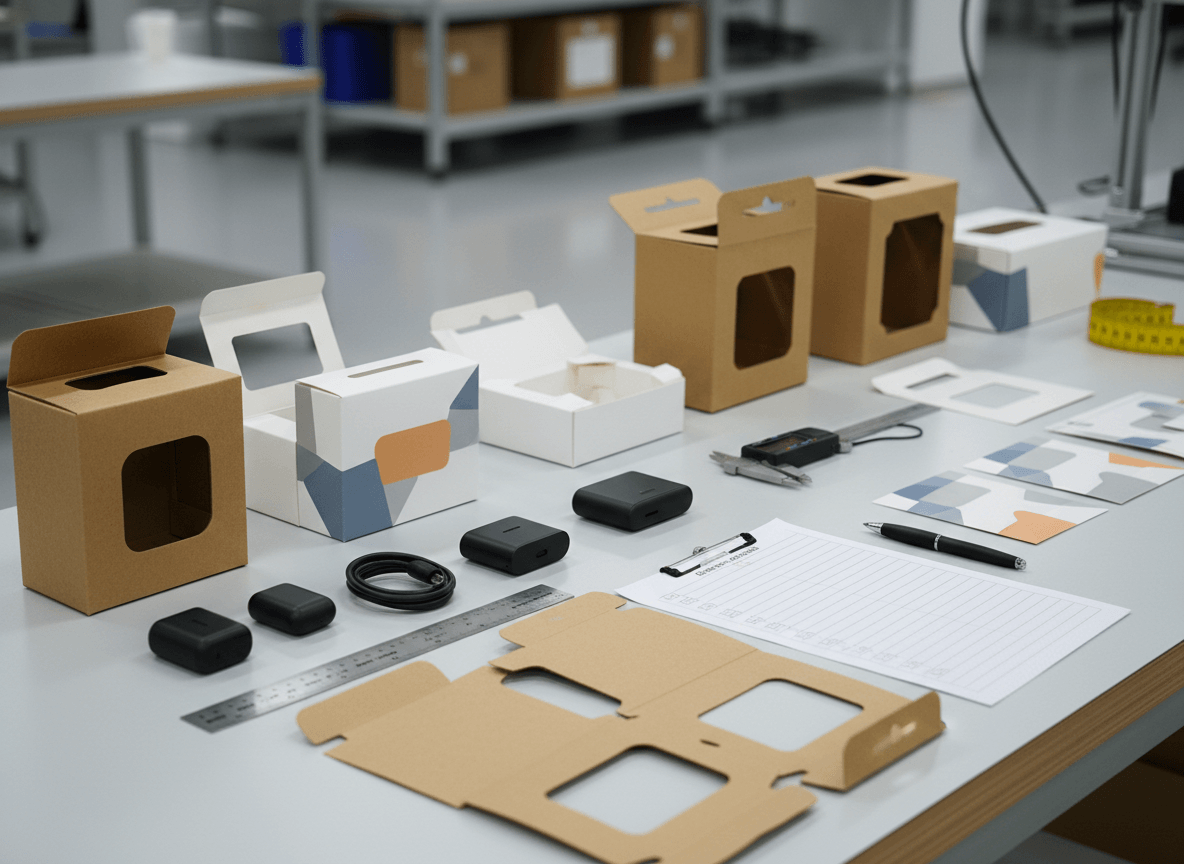
Before confirming the packaging size, check the actual product dimensions.
Do not rely only on estimated product size or early design files. For electronics accessories, even small differences can affect the box structure, insert fit, and carton packing.
Confirm:
- Product length
- Product width
- Product height
- Product thickness
- Cable coil size
- Plug or connector size
- Raised parts or curved edges
- Size tolerance
- Full product set size
If possible, send the physical product sample to your packaging supplier before final sample approval.
For multi-piece packaging, measure every item separately. A charger, cable, manual, warranty card, and accessory part may all affect the final inner layout.
2. Confirm Product Weight
Product weight affects material choice, insert support, hanging strength, and carton packing.
This is especially important for hanging retail packaging. A lightweight cable package may only need a simple hang hole, while a heavier charger set may need stronger paperboard, a reinforced hang tab, or a different display solution.
Confirm:
- Single product weight
- Full set weight
- Packaging weight
- Weight after insert is added
- Weight after retail box is completed
- Carton weight after packing
Do not approve hanging packaging without checking the actual product weight.
3. Confirm the Full Accessory Layout
Many electronics accessories are sold with more than one component.
Before production, confirm exactly what goes inside the box.
Common components include:
- Main product
- Cable
- Adapter
- Earbuds case
- Manual
- Warranty card
- Barcode label
- Product card
- Protective sleeve
- Extra parts
The supplier should know whether each item needs a fixed position, a separate compartment, or simple loose packing.
If the layout is not confirmed clearly, the sample may look acceptable, but mass production may still have packing problems.
4. Check the Insert or Inner Support
The insert should match the product, not just the box.
For electronics accessories, inserts are often used to keep products organized, reduce movement, and improve presentation. They may be paperboard inserts, paper cards, molded trays, blister trays, EVA, foam, or other internal supports.
Before production, confirm:
- Insert material
- Insert thickness
- Product cavity size
- Product placement direction
- Accessory compartments
- Ease of packing
- Whether the product moves after shaking
- Whether the insert is too tight
- Whether the insert affects box closing
If the product is light and not fragile, a simple paperboard structure may be enough. If the product has multiple components or needs stronger protection, custom inserts should be checked carefully before approval.
5. Check the Packaging Structure
By this stage, the box structure should already be selected. The goal now is not to compare every box type again, but to confirm whether the chosen structure is ready for production.
Check:
- Box style
- Opening direction
- Closing method
- Folding lines
- Glue area
- Window area
- Hanging area
- Insert position
- Box strength
- Assembly method
- Packing efficiency
Open and close the sample several times. If the box is difficult to assemble, easy to deform, or hard to close after the product is inside, the structure should be adjusted before mass production.
For many lightweight electronics accessories, custom folding boxes are still one of the most practical production-ready structures because they support retail printing, efficient assembly, and compact carton packing.
6. Confirm Hanging Display Details
If the packaging will be displayed on retail hooks, the hanging area must be checked before production.
Confirm:
- Hang hole shape
- Hang hole position
- Distance from the top edge
- Paperboard thickness
- Product weight
- Reinforced area
- Plastic hook requirement
- Retail display direction
- Long-term hanging pressure
The hanging hole should not be placed too close to the edge. For heavier products, the top area may need reinforcement.
Do not approve hanging packaging based only on appearance. Always check whether it can hold the product weight.
7. Check Artwork and Dieline Carefully

Artwork mistakes are one of the most common causes of delay before mass production.
Before printing, confirm that the artwork matches the final dieline.
Check:
- Correct dieline version
- Bleed area
- Cutting line
- Folding line
- Glue area
- Window position
- Hang hole position
- Barcode position
- Logo position
- Text direction
- Front and back panel layout
- Color mode
- Pantone color if needed
The artwork should be checked on the actual dieline, not only as a flat design image.
If the product has several models, cable types, colors, or market versions, confirm that each artwork file matches the correct SKU.
8. Confirm Product Text and Label Information
Electronics accessories often need clear technical and market information.
Before production, confirm all packaging text and labels.
Check:
- Product name
- Model number
- Compatibility
- Cable length
- Charging type
- Voltage or power information
- Warning text
- Barcode
- QR code
- Recycling marks
- Importer information
- Distributor information
- Country or region information
- Multilingual text
For retail packaging, the barcode should be easy to scan and not placed near folds, corners, or curved surfaces.
For products sold in different markets, confirm whether each market needs different language, symbols, or label details.
9. Confirm Printing and Finishing
Printing and finishing should support the product positioning, not create unnecessary cost.
Before production, confirm:
- Printing method
- Color standard
- Matte or gloss lamination
- Spot UV
- Foil stamping
- Embossing
- Debossing
- Window film
- Surface texture
- Scratch resistance
- Color tolerance
- Approved sample reference
For cost-sensitive electronics accessories, clean printing and accurate structure are usually more important than adding too many decorative finishes.
If premium finishing is used, confirm its position on the sample before mass production.
10. Check the Physical Sample
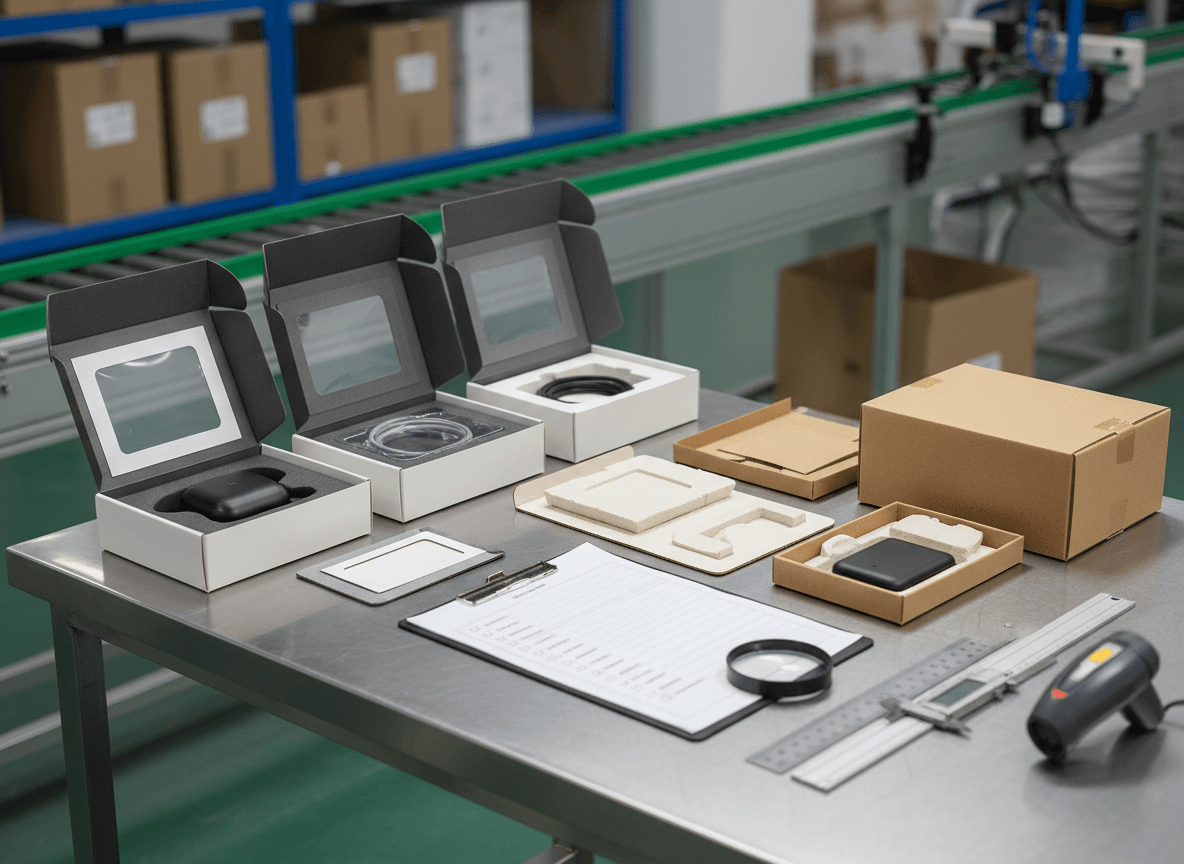
The physical sample is the most important reference before production.
Do not approve the sample only by looking at photos. If possible, check the real sample with the actual product inside.
Review:
- Product fit
- Box size
- Insert fit
- Printing color
- Text accuracy
- Barcode position
- Window position
- Hanging strength
- Box closing
- Assembly process
- Product movement
- Overall presentation
If the sample does not include the real product, mark it clearly as a structure sample only.
Final approval should be based on the complete packaging sample with the product or full product set inside.
11. Confirm Carton Packing
Retail packaging must also work inside the master carton.
Before mass production, confirm carton packing details.
Check:
- Quantity per carton
- Inner box arrangement
- Carton size
- Carton weight
- Carton material
- Carton marks
- Shipping labels
- Pallet requirement
- Empty space inside carton
- Risk of compression
- Export packing method
A small change in retail box size may affect carton quantity and shipping cost.
Confirm carton packing before approving the final box size.
12. Confirm Quantity and SKU Versions
If you have several product models or design versions, confirm the quantity for each version clearly.
Check:
- Total order quantity
- Quantity per SKU
- Quantity per color
- Quantity per artwork
- Quantity per market version
- Extra units for replacement
- Carton quantity
- Production loss allowance
This is especially important for electronics accessories because one product line may include several models, colors, plug types, or cable lengths.
A clear quantity breakdown helps avoid printing the wrong quantity for one version.
13. Confirm Production Timeline
Before approving production, confirm the timeline with your supplier.
Check:
- Final artwork approval date
- Sample approval date
- Material preparation time
- Printing schedule
- Finishing schedule
- Die-cutting time
- Gluing or assembly time
- Insert production time
- QC time
- Packing time
- Shipment date
If the packaging includes blister trays, EVA inserts, molded inserts, or special finishing, production may take longer.
Do not confirm a launch date without confirming the packaging production timeline.
14. Confirm Quality Control Standards
Before mass production starts, agree on basic quality control expectations.
Check:
- Color tolerance
- Paperboard thickness
- Glue quality
- Cutting accuracy
- Folding accuracy
- Surface scratches
- Window film quality
- Insert fit
- Box deformation
- Printing defects
- Carton packing condition
For electronics accessory packaging, the most important quality points are usually structure accuracy, clean printing, product fit, and stable carton packing.
If there is an approved sample, both sides should use it as the production reference.
15. Final Approval Checklist
Before production starts, use this quick checklist:
| Checklist Item | Status |
|---|---|
| Product size confirmed | Yes / No |
| Product weight confirmed | Yes / No |
| Full accessory list confirmed | Yes / No |
| Box structure confirmed | Yes / No |
| Insert layout confirmed | Yes / No |
| Hanging display checked | Yes / No |
| Artwork matched with dieline | Yes / No |
| Barcode position confirmed | Yes / No |
| Label information confirmed | Yes / No |
| Printing and finishing confirmed | Yes / No |
| Physical sample approved | Yes / No |
| Carton packing confirmed | Yes / No |
| Quantity per SKU confirmed | Yes / No |
| Production timeline confirmed | Yes / No |
| QC standard confirmed | Yes / No |
If any answer is “No,” do not approve mass production yet.
Conclusion
A good electronics accessories packaging project should not move to production until all key details are confirmed.
Before approving mass production, brands should check product size, product weight, accessory layout, insert fit, hanging display strength, artwork, labels, printing, sample quality, carton packing, quantity breakdown, production timeline, and quality standards.
This checklist helps reduce misunderstandings, avoid rework, and make packaging production more predictable.
QX Packs helps brands develop custom electronics accessories packaging with structure suggestions, custom inserts, sample support, retail-ready printing, and production follow-up for international orders.
Need Help Checking Your Packaging Before Production?
Send us your product size, weight, accessory list, artwork status, and sample photos on WhatsApp. QX Packs can help you review the key packaging details before mass production.
FAQ
What should I confirm before producing electronics accessories packaging?
You should confirm product size, product weight, accessory layout, insert fit, artwork, barcode position, label information, sample quality, carton packing, quantity, timeline, and QC requirements before mass production.
Why is a physical sample important before mass production?
A physical sample helps confirm product fit, box structure, insert layout, printing quality, hanging strength, and carton packing before the full order is produced.
Should I approve packaging production based only on artwork?
No. Artwork approval is not enough. You should also approve the structure, product fit, insert layout, material, finishing, barcode position, and physical sample.
What is the most common mistake before packaging production?
One common mistake is approving the design before checking the actual product size and accessory layout. This can lead to poor fit, product movement, or incorrect box size.
Can QX Packs help review packaging details before production?
Yes. QX Packs can help check product dimensions, box structure, custom inserts, artwork details, sample fit, and production requirements before mass production.