
Introduction
Electronics accessory packaging needs to do more than hold the product.
For cables, chargers, phone cases, earbuds, USB accessories, battery products, and other small consumer electronics, packaging must support retail display, protect the product during international shipping, and make product information clear for buyers.
A package that looks good on a retail shelf may still fail if the product moves inside the box during shipping. A box that protects the product well may also be too large, too expensive, or unsuitable for hanging display.
That is why electronics accessory packaging should be planned based on product size, weight, accessory list, sales channel, target market, and shipping method before sampling begins.
This guide explains what brands should prepare before developing electronics accessory packaging for retail display and international shipping.
Why Retail Display and International Shipping Must Be Planned Together
Retail packaging and shipping packaging are often treated as separate topics, but they are closely connected.
Retail packaging needs to present the product clearly. It may need a hang hole, window area, barcode position, product specifications, or multilingual information. The packaging must look organized and be easy for customers to understand.
International shipping requires a different level of planning. The product may pass through factory packing, export cartons, sea or air shipment, warehouses, distributors, and retail stores before reaching the final customer.
If the packaging is not planned carefully, common problems can happen:
- The product moves inside the box
- The hanging area tears during display
- The window area becomes weak or damaged
- The retail box is crushed inside the master carton
- The box size increases shipping cost
- The label or barcode position is not suitable for the target market
- The supplier cannot quote accurately because product details are incomplete
A good packaging plan should balance display, protection, cost, and shipping efficiency at the same time.
Start With Product Size, Weight, and Accessory List
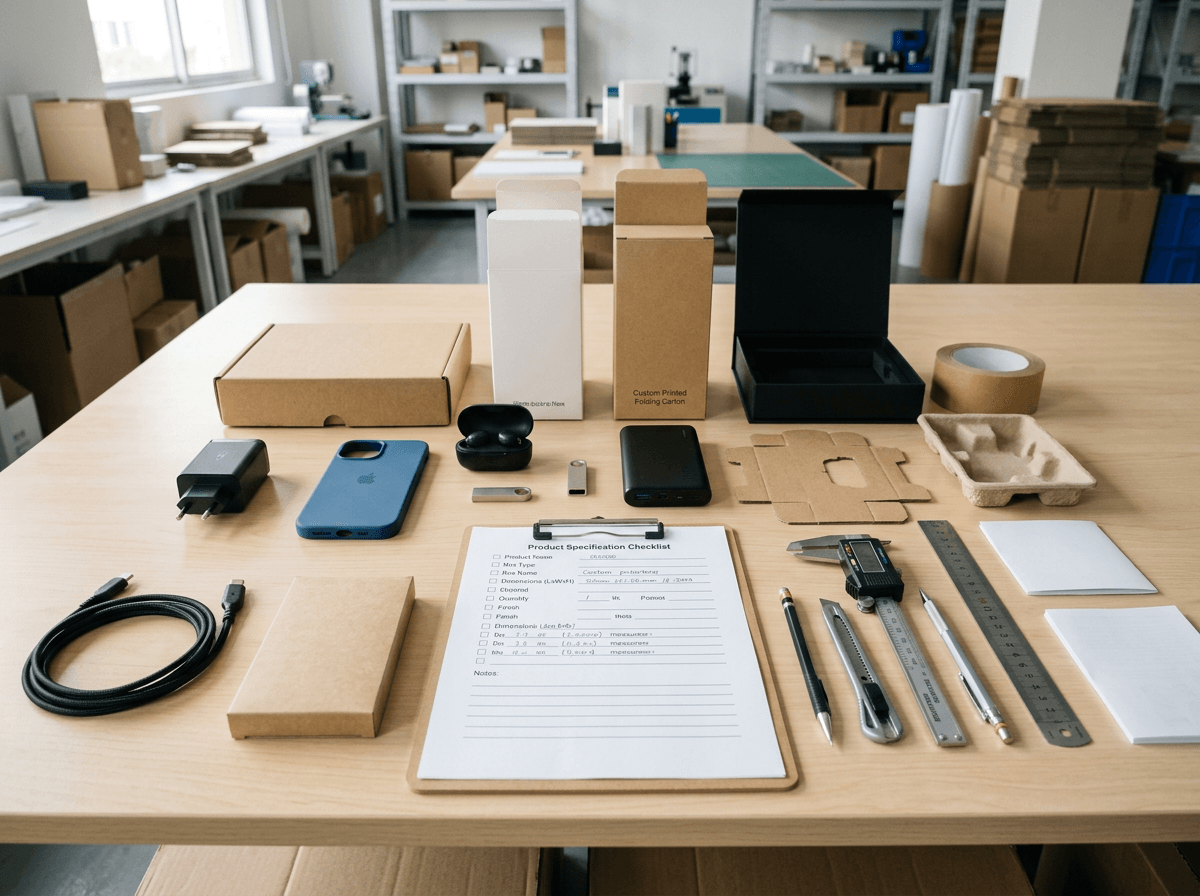
Before choosing the packaging structure, the first step is to confirm the actual product details.
For electronics accessories, small differences in product size can affect the box size, insert layout, window position, hanging area, and carton packing quantity.
Brands should prepare accurate product information before asking for a quotation.
Product Size
Provide the length, width, and height of the product.
If the product has an irregular shape, curved edge, cable coil, plug, or raised part, photos or a physical sample are helpful.
For example, a phone case, charging cable, USB product, and earbuds case may all look small, but their packaging layouts can be very different.
Product Weight
Product weight affects paperboard strength, hanging display safety, insert selection, and carton packing.
For hanging retail display, weight is especially important. If the hang hole or paper tab is not strong enough, the package may bend, tear, or fall from the retail hook.
Accessory List
Many electronics products include more than one item.
For example:
- Main product
- Charging cable
- Adapter
- Manual
- Warranty card
- Extra parts
- Paper card
- Protective sleeve
- Barcode or label
For products with multiple components, the packaging should be planned around the full set, not only the main product.
For products with multiple components, custom inserts should be planned together with the product layout and box size.
Plan the Retail Display Method Before Sampling
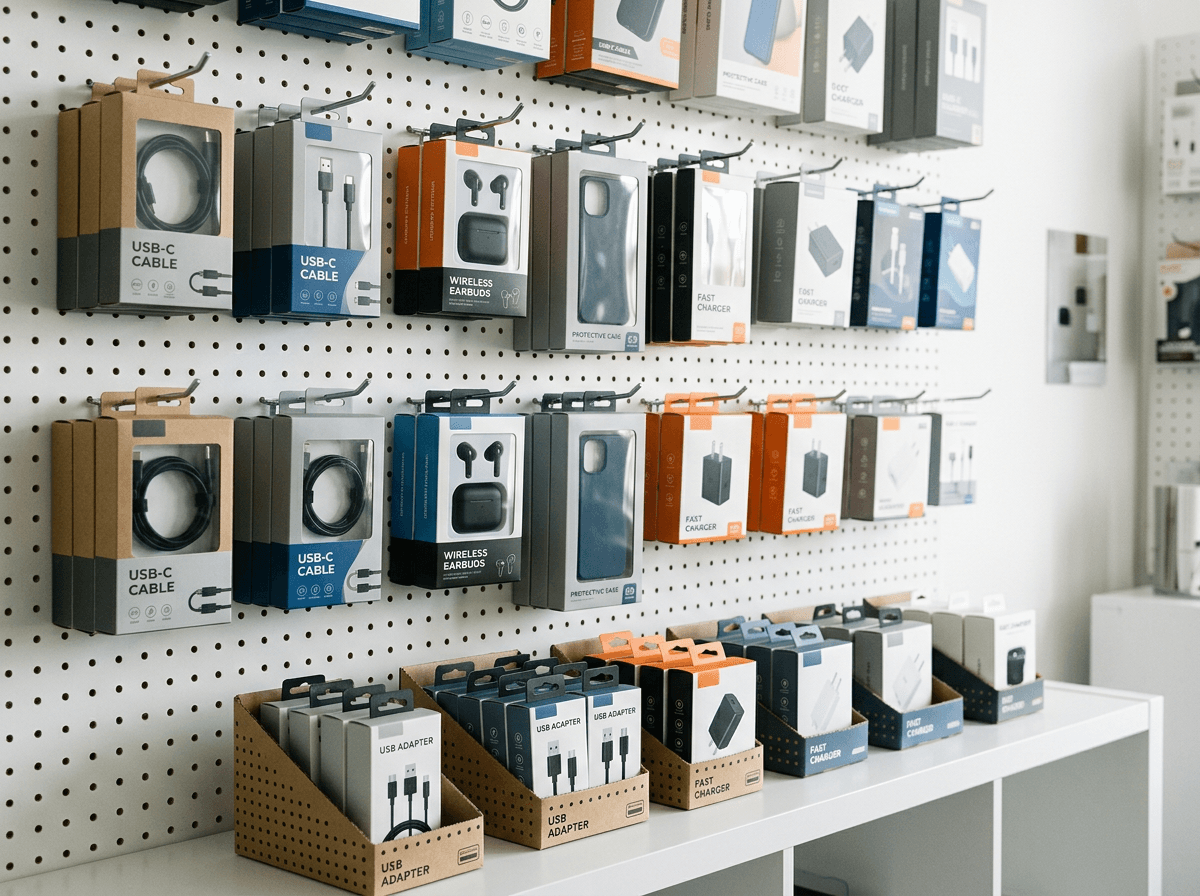
The retail display method should be confirmed before making the sample.
Different sales channels need different packaging details. A box for supermarket hanging display may not be the same as a box for e-commerce delivery or distributor shipment.
Shelf Display
If the product will be placed on a shelf, the front panel needs clear product information and a clean visual layout.
The box should stand properly and should not be too thin or unstable.
Hanging Display
If the product will be displayed on a retail hook, the packaging needs a suitable hang hole, reinforced paper tab, or plastic hook.
The supplier should check:
- Product weight
- Hanging hole position
- Paperboard thickness
- Distance from the top edge
- Display direction
- Long-term hanging pressure
Lightweight cables or small accessories may use a simple paper hang hole. Heavier products may need a reinforced hanging area or plastic hook.
Window or Product Visibility
Some electronics accessories need product visibility. For example, phone cases, earbuds, cables, and small USB products may benefit from a window or blister display.
However, visibility should not weaken the package too much. A large window can reduce box strength and may increase production complexity.
If cost control is important, printed product images may be more practical than a large clear window.
For many lightweight electronics accessories, custom folding boxes can support retail printing, hanging display, and efficient shipping.
Check International Shipping and Carton Packing Requirements
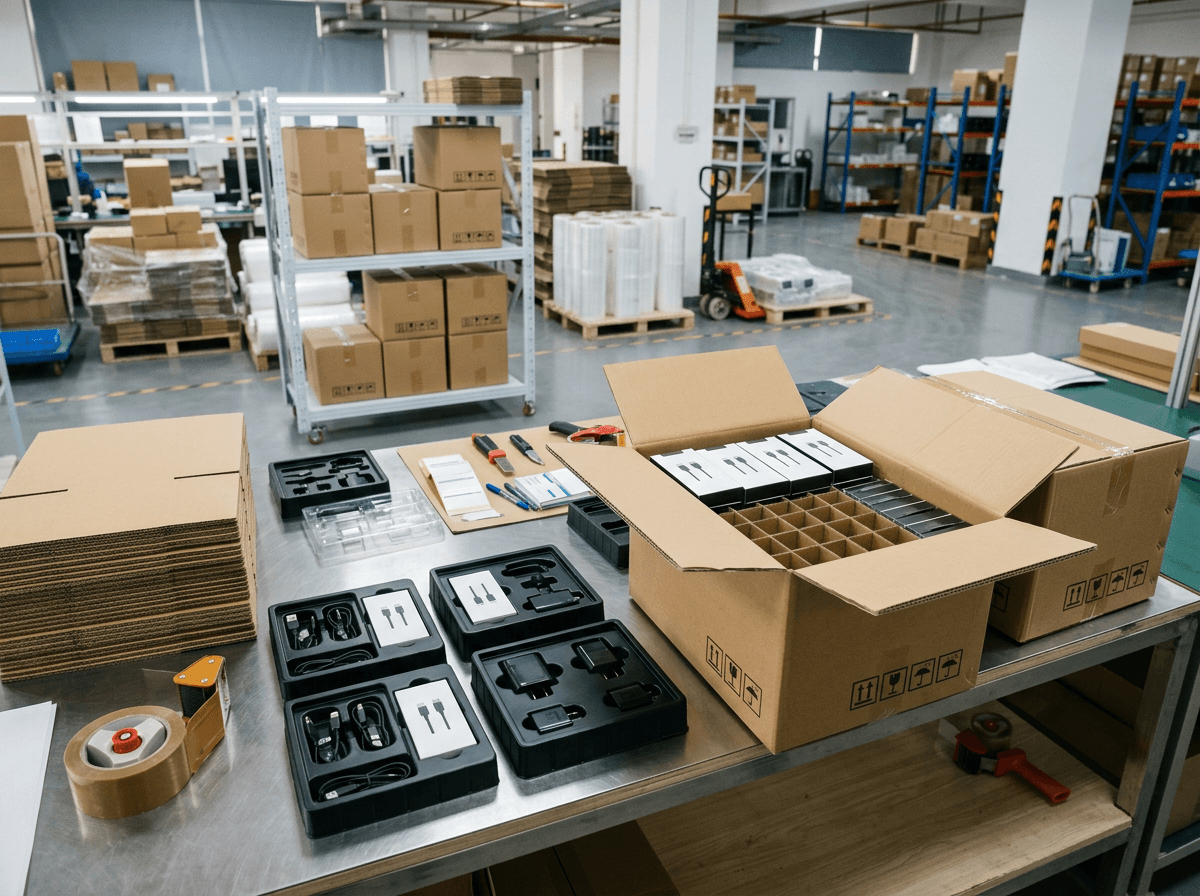
Packaging should not be designed only as a single retail box.
For international orders, the retail box must also fit into master cartons efficiently. This affects shipping cost, carton strength, and damage risk.
Before finalizing the packaging size, brands should confirm:
- Retail box size
- Quantity per master carton
- Master carton size
- Carton weight
- Shipping method
- Stacking requirement
- Product movement inside the box
- Inner box arrangement inside the carton
A slightly oversized retail box can create higher freight cost when multiplied by thousands of units.
For example, if the box has too much empty space around a cable, charger, or phone case, the product may move during shipping and the carton may also take up more space than necessary.
A practical packaging solution should be checked together with master carton size, packing quantity, and shipping method.
Confirm Target Market and Labeling Information
Electronics accessory packaging often needs clear product information.
Before printing, brands should confirm the target market and required label details.
Common information may include:
- Product name
- Compatibility
- Cable length
- Charging type
- Voltage or power information
- Barcode
- QR code
- Warning text
- Recycling marks
- Battery-related information
- Importer or distributor information
- Multilingual instructions
Different markets may require different text, symbols, or label positions.
If the packaging is for retail stores, the barcode should be placed in a clear and scannable area. If the product is for international distributors, carton marks and product labels should also be confirmed before mass production.
These details should be checked before sample approval, not after printing.
How to Avoid Oversized or Overcomplicated Packaging
Electronics accessories are usually small products, so packaging cost and shipping volume need to be controlled carefully.
A common mistake is making the package larger than necessary to make the product look more visible. This may increase material cost, carton volume, warehouse space, and freight cost.
Another mistake is adding complex inserts or surface finishing too early.
For many small electronics accessories, the most practical solution is often a compact structure, clear printing, suitable internal support, and a display method that matches the sales channel.
To control cost, brands should consider:
- Keep the box size close to the actual product size
- Avoid unnecessary empty space
- Use simple paperboard support when possible
- Use blister or molded trays only when needed
- Avoid large windows if product visibility is not essential
- Limit premium finishing for cost-sensitive products
- Confirm carton packing before finalizing box size
- Avoid changing the structure after sample approval
The goal is not to make the packaging complicated. The goal is to make it easy to display, easy to understand, safe to ship, and efficient to produce.
What to Send Your Packaging Supplier Before Quotation
To get a useful quotation, do not only ask for “a box price.”
A packaging supplier needs enough product and project information to recommend the right structure and estimate the cost correctly.
Before requesting a quote, prepare the following information:
| Item | Details to Prepare |
|---|---|
| Product |
Product type, size, weight, photos, and sample status. Example: Cable, charger, phone case, earbuds, USB product, battery accessory. |
| Accessories |
Main product and all included components. Example: Cable, adapter, manual, warranty card, extra parts. |
| Packaging |
Preferred style, window, hanging display, insert, barcode area, and text needs. Example: Window box, hang hole, paper insert, barcode area, multilingual text. |
| Sales & Shipping |
Sales channel, target market, quantity, shipping method, and delivery time. Example: Retail store, EU market, 3,000 pcs, sea shipment. |
| Artwork |
Artwork file, dieline need, logo file, colors, and finishing requirements. Example: AI artwork ready, need dieline, Pantone color, matte lamination. |
The clearer the information, the faster the supplier can recommend a practical solution and prepare an accurate quotation.
Sample Review Before Mass Production
A physical sample is important before mass production.
For electronics accessory packaging, the sample should not only be checked for appearance. It should also be checked for product fit, display function, carton packing, and production feasibility.
Before approving the sample, review the following points:
- Does the product fit correctly?
- Does the product move inside the package?
- Is the insert or inner support practical?
- Is the hang hole strong enough?
- Is the window position accurate?
- Is the barcode position clear?
- Is the printed information correct?
- Is the box size suitable for carton packing?
- Is the structure easy to assemble?
- Does the packaging match the target retail channel?
If there are multiple accessories in one package, check the full set together. Do not approve the sample based only on the main product.
Once the sample is approved, avoid changing the box size, layout, insert, or artwork unless necessary. Late changes can increase cost and delay production.
Conclusion
Electronics accessory packaging should be planned around both retail display and international shipping.
Before sampling, brands should confirm product size, weight, accessory list, sales channel, display method, target market, labeling information, and shipping requirements.
For cables, chargers, phone cases, earbuds, USB accessories, batteries, and other small electronics products, the best packaging is not always the most complex option. It is the option that fits the product correctly, displays clearly, protects during shipping, and keeps production and freight cost under control.
QX Packs helps brands develop custom electronics accessory packaging with practical structure recommendations, sample support, custom inserts, retail-ready printing, and production support for international orders.
Frequent Asked Questions
What information should I provide before requesting electronics accessory packaging?
You should provide the product type, product size, weight, accessory list, target market, display method, order quantity, and packaging preference. This helps the supplier recommend a more suitable packaging structure and quote more accurately.
Why is product weight important for retail packaging?
Product weight affects paperboard strength, insert design, hanging hole position, and carton packing. For hanging retail display, the packaging must support the product weight without tearing or deforming.
Can the same packaging be used for retail display and international shipping?
Yes, but the structure must be checked carefully. Retail packaging needs good display performance, while international shipping requires stable product support, suitable carton packing, and enough structural strength.
Do all electronics accessories need custom inserts?
Not always. Lightweight products may only need a paper card or simple folded structure. Products with multiple parts or fragile components usually need custom inserts or trays for better organization and protection.
How can I reduce packaging cost for electronics accessories?