How to Plan Custom Packaging for Multiple SKUs Without Losing Control of Cost, Inserts, and Artwork
A practical production guide for brands managing multiple product sizes, packaging designs, inserts and order quantities across one product range
Planning packaging for an entire product range with multiple SKUs is a different type of project.
Even when the products belong to the same range, they may have different dimensions, quantities, inserts, labels, artwork files or retail requirements. Without a clear system, brands can lose control of tooling costs, packaging sizes, sample revisions and artwork versions.
The key is not to treat every SKU as a completely separate packaging project. It is to identify which elements can be shared and which must remain SKU-specific.
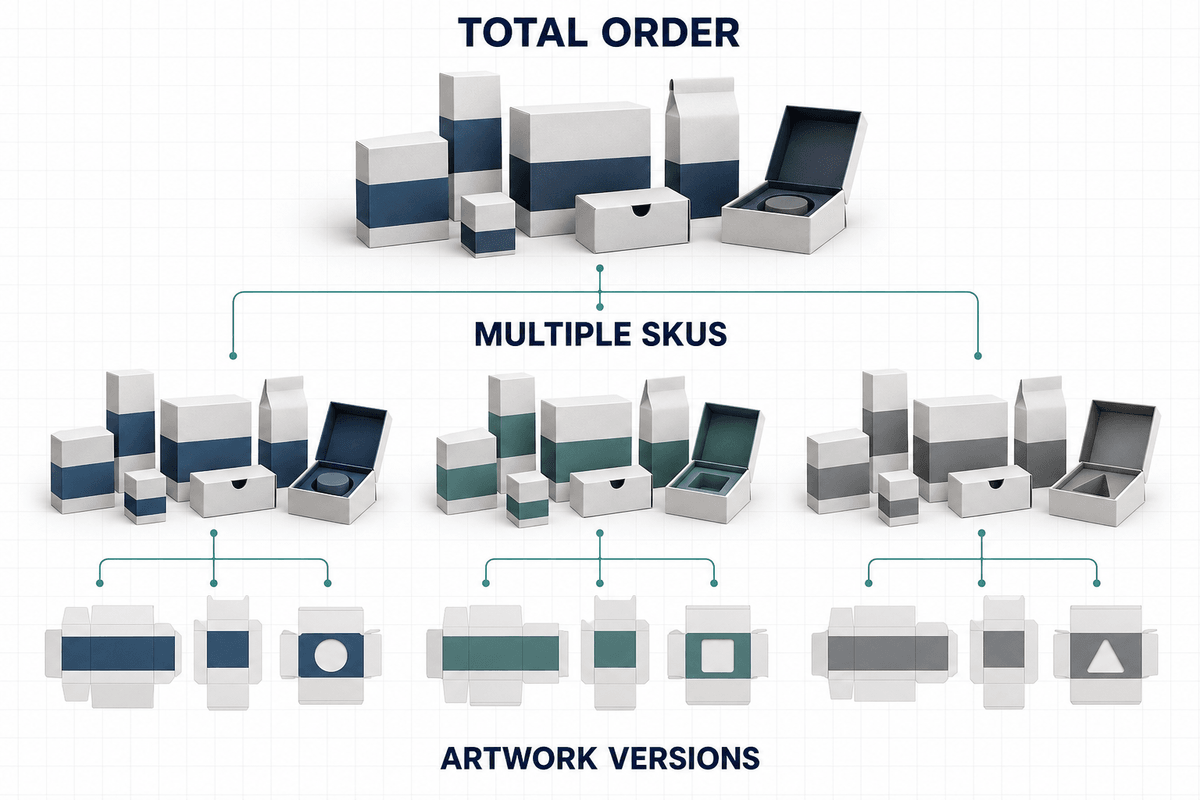
For most multi-SKU projects, the manufacturer needs to review three different quantities:
- Total project quantity
- Quantity per SKU
- Quantity per printed design
These quantities are not interchangeable. A project with 10,000 boxes across 20 SKUs is different from one design with an order quantity of 10,000 pieces.
This guide is intended for established brands, product managers and packaging buyers planning commercial production across multiple SKUs. For many custom printed paper packaging projects, 1,000 pieces per design is a practical starting point. Orders of around 500 pieces per design may be reviewed only when the size, structure, materials and production setup are compatible.
What Does Multi-SKU Packaging Mean?
An SKU, or stock-keeping unit, is a specific product variation that needs to be identified and managed separately.
Different SKUs may be created by changes in:
- Product size
- Product model
- Color
- Fragrance
- Flavor
- Product strength or formula
- Set configuration
- Language
- Label
- Barcode
- Packaging artwork
For example, a skincare range may use the same bottle shape but contain different formulas. An electronics range may include several charger sizes, cable lengths or plug types. A health-product range may include multiple bottle sizes and kit combinations.
The products may look related to the customer, but the packaging manufacturer still needs to know what changes from one SKU to another.
Start with Three Quantity Numbers
One of the most common sources of confusion in multi-SKU packaging is quantity.
1. Total Project Quantity
This is the total number of boxes across the complete product range.
For example:
- 6 SKUs
- 500 boxes per SKU
- 3,000 boxes in total
The total quantity helps the manufacturer understand the overall scale of the project, but it does not automatically determine the production cost of every design.
If the total quantity is divided among too many SKUs, the quantity per SKU or printed design may still be below a practical production level.
2. Quantity per SKU
This shows how many packages are required for each product variation.
The quantity may be evenly divided, or some products may need higher volumes than others. A brand could need 1,000 boxes for its main product and only 500 boxes for each secondary variation.
Always provide the quantity for every SKU instead of giving only the total project quantity.
As a practical planning direction, buyers should list the quantity for every SKU and printed design before combining the project total. For many custom printed paper packaging projects, 1,000 pieces per design is a more practical starting point. Around 500 pieces per design may be reviewed for compatible production groups, but shared size and materials do not automatically guarantee that different artwork versions can be combined.
3. Quantity per Printed Design
Two SKUs may use the same box size but have different printed artwork, colors, barcodes or product information.
Each printed version may require separate:
- Printing preparation
- Color control
- Artwork checking
- Production sorting
- Quality inspection
- Packing and identification
This is why a total quantity of 3,000 boxes divided among many printed designs may not reach a practical production quantity for each version. Multi-SKU projects should therefore be planned according to the quantity per printed design—not only the combined project total.
If one printed version is below a practical production quantity, the buyer may need to increase its quantity, reduce the number of printed versions, group compatible designs, or use a shared generic box with separate labels or sleeves. Final feasibility should be reviewed according to box size, structure, material, printing method and insert requirements.
Can Multiple SKUs Share the Same Box?
Yes, multiple SKUs can sometimes share the same outer box, but only when their physical and presentation requirements are compatible.
The decision should begin with product dimensions, weight and protection—not only visual branding.
| Packaging Approach | Best Suited For | Production and Cost Considerations |
|---|---|---|
| Same box size and same artwork | Products with similar dimensions that can be identified by a separate label | The simplest approach, with fewer printed versions and easier inventory control |
| Same box size with different artwork | Products with similar dimensions but different branding or product information | The box structure can be shared, but every printed design must be quoted by its own quantity |
| Same outer box with different inserts | Products that fit the same external dimensions but need different internal support | The outer structure may be shared, while each insert requires separate evaluation |
| Same box with different labels or sleeves | Product variations that do not require fully different printed boxes | Can simplify inventory, but labeling and packing accuracy become important |
| Different box sizes for different SKU groups | Products with clearly different dimensions or weights | More structures and samples are required, but product fit and material efficiency may improve |
| Completely different packaging for every SKU | Products with different structures, sales channels or presentation requirements | Usually creates the highest tooling, sampling and production-management cost |
Before deciding, group products by actual size and packaging requirements. Do not group them only by product category.
If you are still comparing outer structures, review our custom rigid boxes and custom folding boxes.
When Can the Outer Box Be Shared?
A shared outer box may be practical when:
- Product dimensions are identical or very similar
- Product weights do not vary significantly
- The same internal box size works for all products
- The insert can be changed without changing the outer structure
- The same retail and shipping requirements apply
- Product identification can be handled through artwork, labels or sleeves
However, using one large box for every SKU is not always the lowest-cost solution.
If smaller products require excessive empty space, additional padding or unnecessarily large inserts, the shared box may increase material use and shipping volume. The final decision should consider both manufacturing efficiency and the packed-product result.
Using Different Inserts with One Outer Box
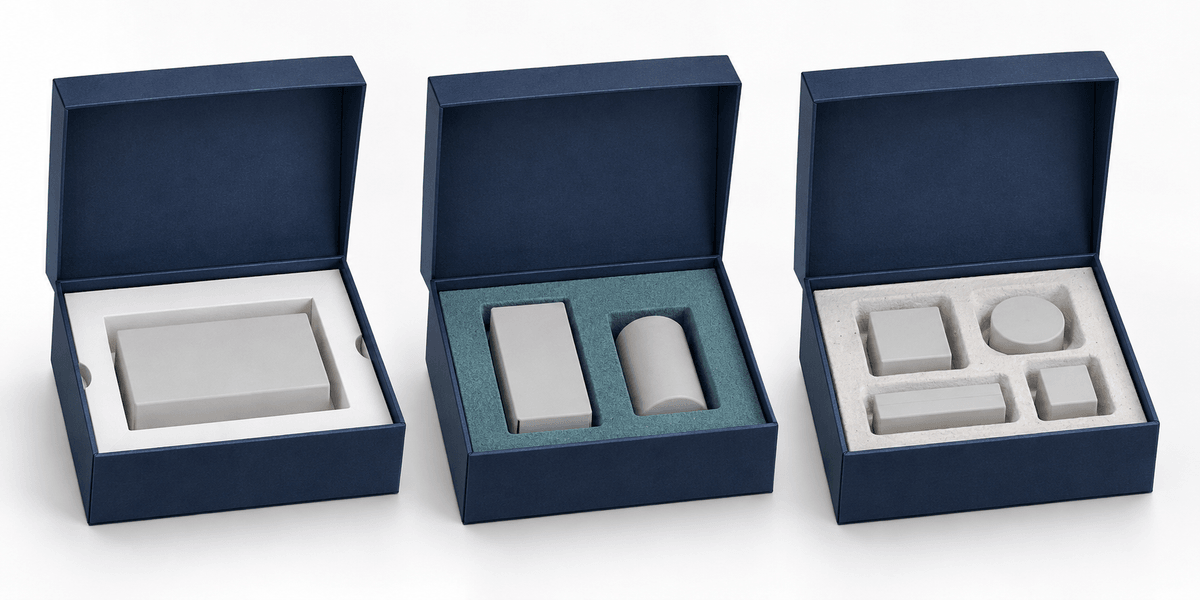
A shared rigid box or folding carton can sometimes support several products through different inserts.
Possible insert materials include:
- Paperboard
- Corrugated paper
- EVA foam
- Other foam materials
- Molded pulp
- Vacuum-formed trays
- Fabric-covered inserts
For example, one outer box size may be used for three related devices, while each device receives a different paperboard or EVA insert.
This can simplify the outer packaging structure, but it does not make every insert identical in cost. Each insert may require different cavities, tooling, material thickness, assembly or testing.
Products with different weights or fragile components may also require separate protection evaluations.
Learn more about structure and material options on our custom inserts page.
Build a Master SKU Packaging List
Before requesting a quotation or starting samples, create one master list for the entire product range.
A practical SKU list should contain:
| Field | Information to Provide |
|---|---|
| SKU name or code | A unique identifier for each product |
| Product dimensions | Length × width × height |
| Product weight | Weight of the item or complete set |
| Quantity per SKU | Required production quantity for each product variation |
| Products per box | One item, multiple items or a complete product kit |
| Preferred box type | Rigid box, folding carton, drawer box or another structure |
| Insert requirement | Material preference, protection needs and required product position |
| Artwork version | File name or version number connected to each design |
| Label or barcode | Variable information required to identify each SKU |
| Special requirements | Fragility, retail display, shipping or presentation requirements |
If your product measurements are not ready, follow our guide on how to measure products for a custom packaging quote.
Group SKUs by Physical Requirements
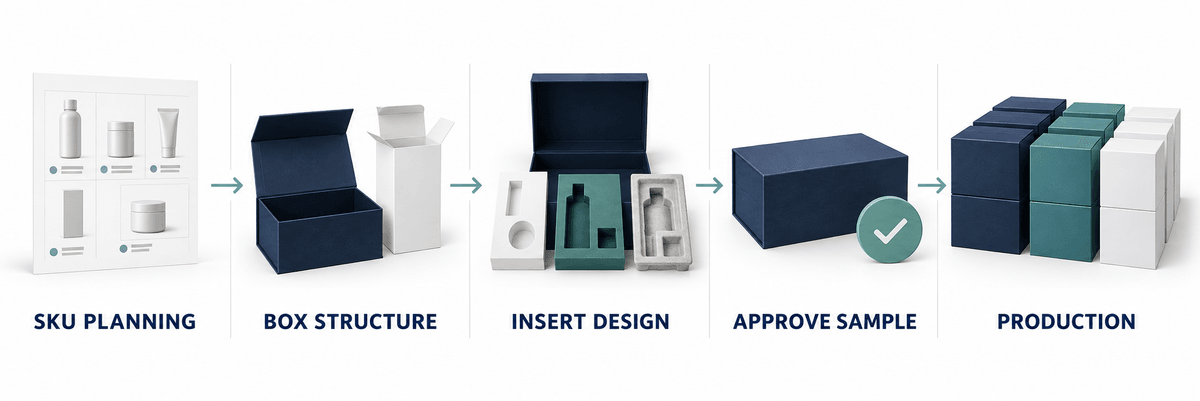
Once the SKU list is complete, divide the products into packaging groups.
Products may belong to the same group when they have:
- Similar dimensions
- Similar weight
- The same box structure
- Compatible insert requirements
- The same sales channel
- Similar shipping and protection requirements
For example, a product range with multiple SKUs may not require a different box structure for every variation. After reviewing the products, they might be organized into:
- One small-product box
- One medium-product box
- One large-product box
- Several insert variations
- Multiple artwork or label versions
This type of grouping can reduce unnecessary structure development while keeping the packaging suitable for each product.
It should be confirmed before artwork is finalized. Designing all printed files first and reviewing the physical packaging later can create avoidable revisions.
Control Artwork with a Version System
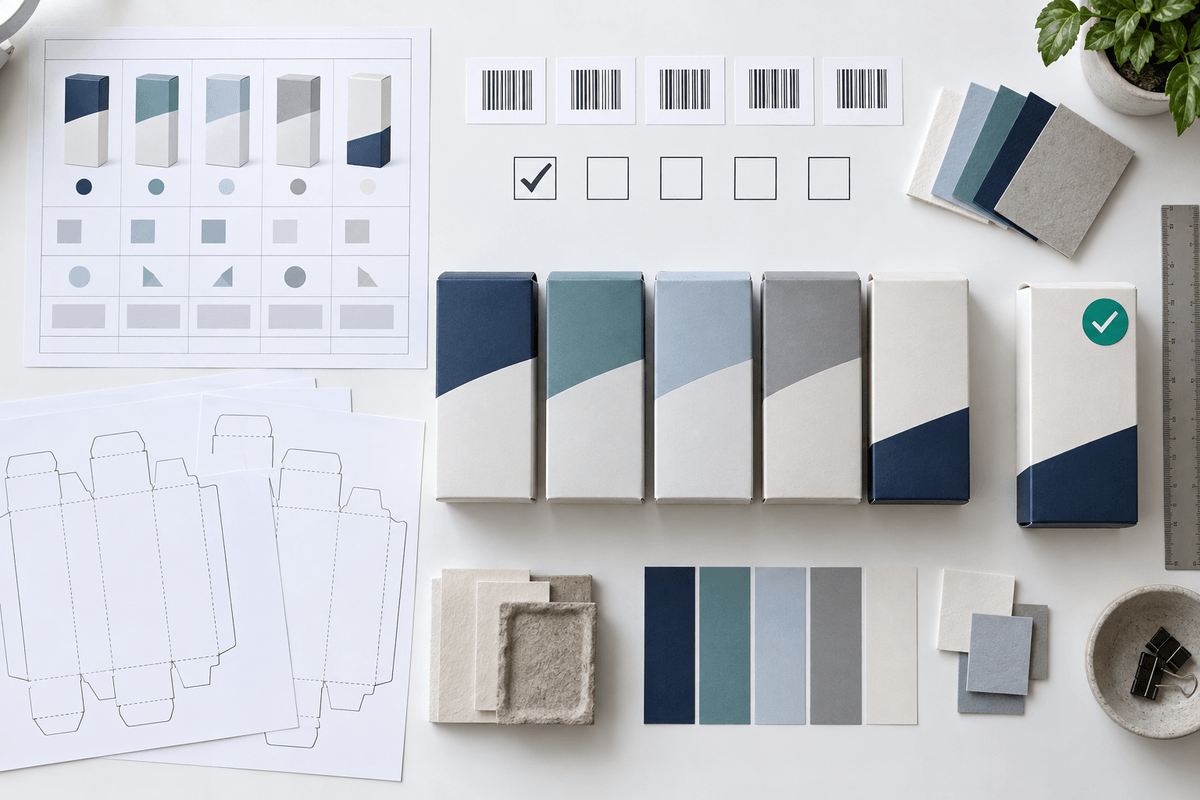
Artwork errors become more likely as the number of SKUs increases.
Every printed file should use a clear naming structure. For example:
Brand_Product_SKU_Language_Version_Date
Your artwork list should also record:
- SKU code
- Box size
- Dieline version
- Language
- Barcode
- Color reference
- Finish requirements
- Approval status
- Final approval date
Avoid file names such as final.pdf, new-final.pdf or final-latest-2.pdf. They do not provide reliable version control when several designs are being checked at the same time.
The approved artwork list should match the production quantity list. Before mass production, confirm that every SKU has the correct:
- Artwork file
- Quantity
- Box size
- Insert
- Label
- Barcode
- Packing instructions
Decide Which Samples Are Actually Needed
A multi-SKU project does not always require a complete finished sample for every variation.
A practical sample strategy may include:
- Confirming the main box structure first
- Testing the most demanding or heaviest product
- Checking one sample for each different insert structure
- Producing one fully printed sample for color and finishing approval
- Using digital proofs or printed proofs for secondary artwork versions
- Expanding to the remaining SKUs after the core structure is approved
However, a separate physical sample may still be necessary when an SKU has a different:
- Product size
- Product weight
- Box structure
- Insert cavity
- Material
- Opening method
- Finishing process
The sample plan should be agreed upon before sample production starts. This prevents the buyer and supplier from having different expectations about what the sample fee includes.
A Multi-SKU Inquiry That Needed Replanning
A health-product packaging inquiry initially included more than 20 SKUs but only approximately 3,000 packages in total.
Although the combined quantity appeared suitable, the quantity allocated to each SKU was too low for separate custom-printed production. The project therefore needed to be reorganized before an accurate production plan could be prepared.
The first task was not to select a paper color or logo finish. It was to understand:
- Which products had the same dimensions
- How the total quantity was divided among SKUs
- Which products were sold individually
- Which products were packed as sets
- Whether the outer box could be shared
- Which SKUs required different inserts or labels
- Which structure should be sampled first
The review focused on whether some SKUs could share the same generic outer box, use separate labels or sleeves, be grouped into fewer printed versions, or increase the quantity per design.
After reorganizing the product range, the packaging could be reviewed as a smaller number of practical production groups instead of many low-quantity printed variations.
The main structure was evaluated first. Product groups, insert variations, labels and artwork versions could then be developed around the approved packaging direction.
This approach makes quotation, sampling and approval easier to manage. It also helps both sides identify which costs are shared and which costs belong to individual SKUs.
What Affects the Cost of Multi-SKU Packaging?
The total cost may be affected by:
- Total project quantity
- Quantity per printed design
- Number of box sizes
- Number of structures
- Number and complexity of inserts
- Printing colors
- Foil stamping, embossing or other finishes
- Number of artwork versions
- Labeling and sorting
- Sample quantity
- Packing requirements
- Shipping volume
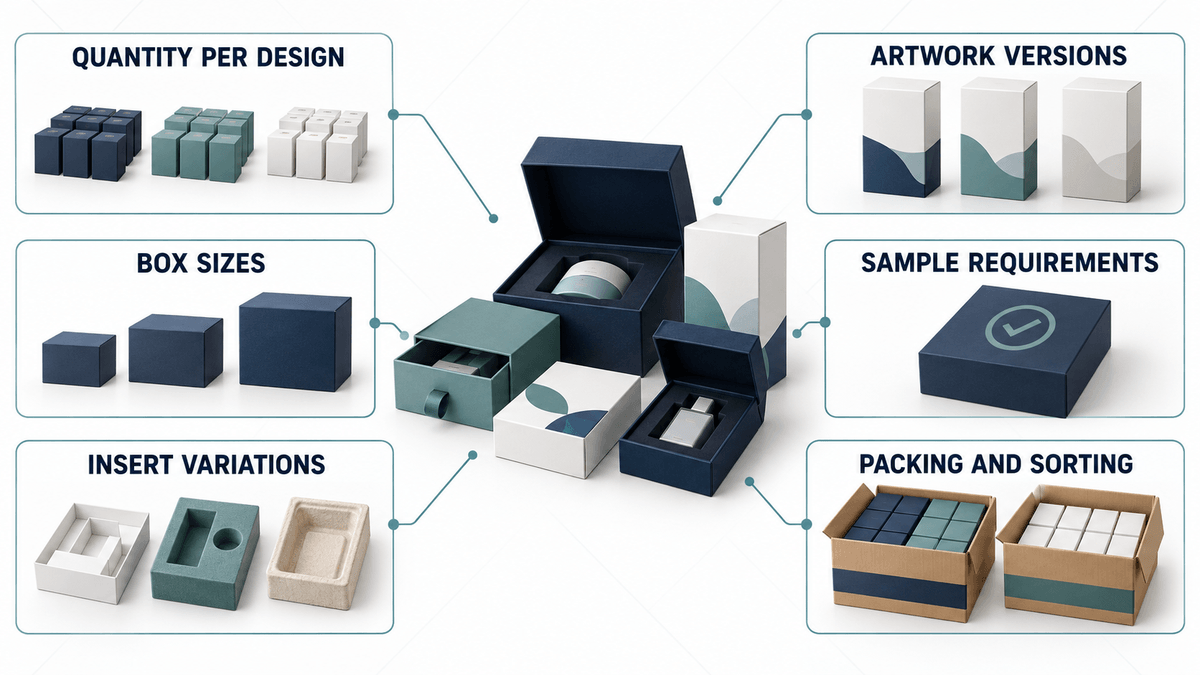
For multi-SKU packaging, the combined order quantity does not automatically qualify every variation for production. Each box size, printed design and insert variation must be evaluated according to its own quantity.
The lowest number of box sizes is not automatically the lowest total cost. The goal is to find the best balance between structural efficiency, product protection, visual consistency and manageable production.
A manufacturer can provide a more useful recommendation when the full SKU range is reviewed together rather than quoted one item at a time.
Information to Send for a Multi-SKU Packaging Review
Prepare the following before contacting a packaging supplier:
- Company or brand name
- Product category
- Complete SKU list
- Product dimensions and weight
- Product photos
- Quantity per SKU
- Total project quantity
- Products packed in each box
- Preferred box style
- Insert requirements
- Artwork status
- Reference packaging photos
- Target market
- Delivery country
- Planned approval or launch date
You do not need to decide every packaging specification before contacting us. However, the product list, dimensions and quantity per design are necessary for a meaningful production review.
Please do not provide only the combined quantity. We need the quantity for every SKU, box size and printed version to review production feasibility.
For a broader quotation preparation guide, see our custom packaging order checklist.
Frequently Asked Questions
Can multiple SKUs use the same custom box?
Yes, if their dimensions, weight and protection requirements are compatible. Different inserts, labels, sleeves or artwork may be used, but each variation still needs to be evaluated.
Does the total project quantity count as the MOQ?
Not always. Production feasibility and unit cost may depend on the quantity per box size, printed design, insert and artwork version—not only the combined project total.
Can the same outer box use different inserts?
Yes. This can be practical when several products fit within the same external box dimensions. Each insert must still be reviewed for product fit, material, cavities and tooling.
Do we need a finished sample for every SKU?
Not necessarily. Some projects can confirm a master box structure and representative insert samples first. Separate samples may be required when dimensions, structures, inserts, materials or finishing processes change.
When should the artwork be prepared?
Packaging structure and dielines should be confirmed before final artwork is completed. For multi-SKU projects, use a version-controlled artwork list linked to each SKU and production quantity.
Plan the Packaging Range as One System
Multi-SKU packaging works best when the full product range is reviewed before individual boxes enter production.
Start with the product list, group SKUs by physical requirements, identify shared and variable packaging elements, confirm quantity per design, and establish one artwork approval system.
This allows the packaging manufacturer to give clearer structural recommendations, separate shared costs from SKU-specific costs and create a more practical sample plan.
QX Packs supports custom packaging development for commercial production projects, including rigid boxes, folding cartons, product kits and custom inserts.
Planning packaging for multiple SKUs?
Send your SKU list, product dimensions, quantity per design, preferred box structure and insert requirements. We will review which products may share the same packaging and which variations require separate development.
Prefer to submit a structured project request?
Include your company or brand, SKU list, product photos, dimensions, quantity per design, insert requirements and delivery country through our contact page.